Story craft · Essay 09
How to Write a Short Story Without Shrinking a Novel
A rainy key shop, one lavender soap impression, and a last bus that refuses to wait for the ending.
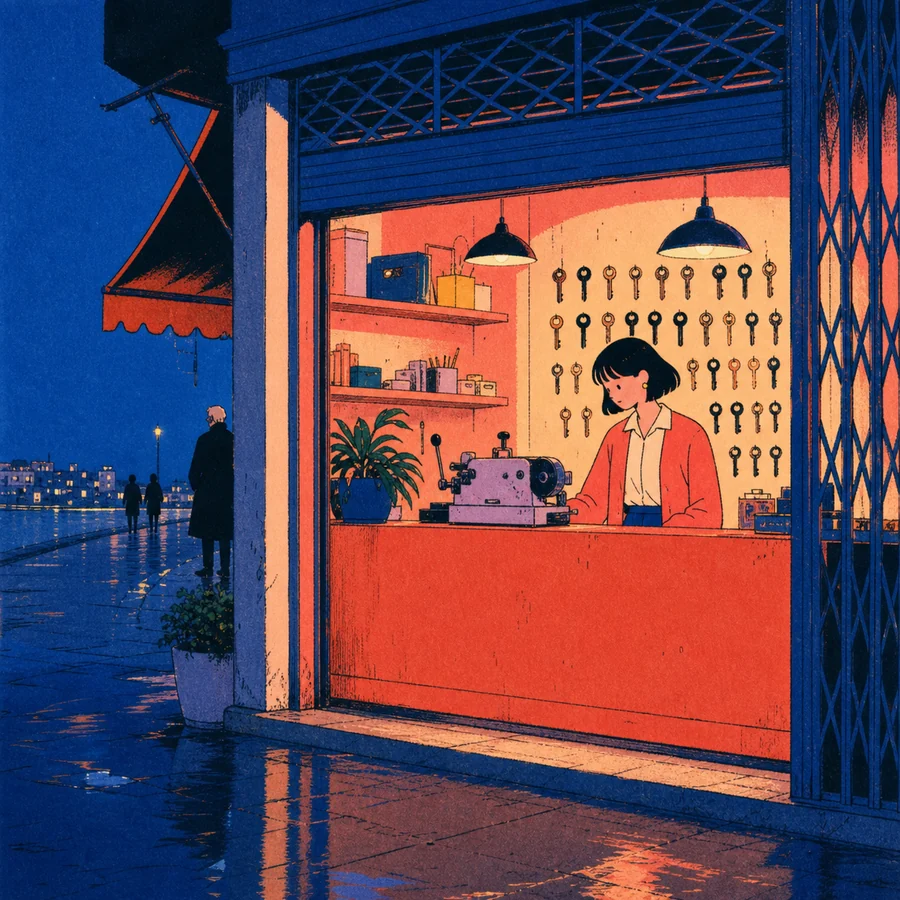
If you want to know how to write a short story, put one person in one changing situation and follow the choice far enough that the room feels different afterward. You do not need twelve named characters. The locksmith's dentist's ex-husband may be fascinating, but the short story is already looking at the clock and hiding the spare chairs.
Lena is closing a neighborhood locksmith shop while rain needles the security grille. On an ordinary night she sweeps brass filings from beneath the key cutter, counts the register, and eats the peppermint she forgot at lunch. The peppermint has welded itself to the wrapper. This is not a tragedy, though it has hired one of tragedy's publicists.
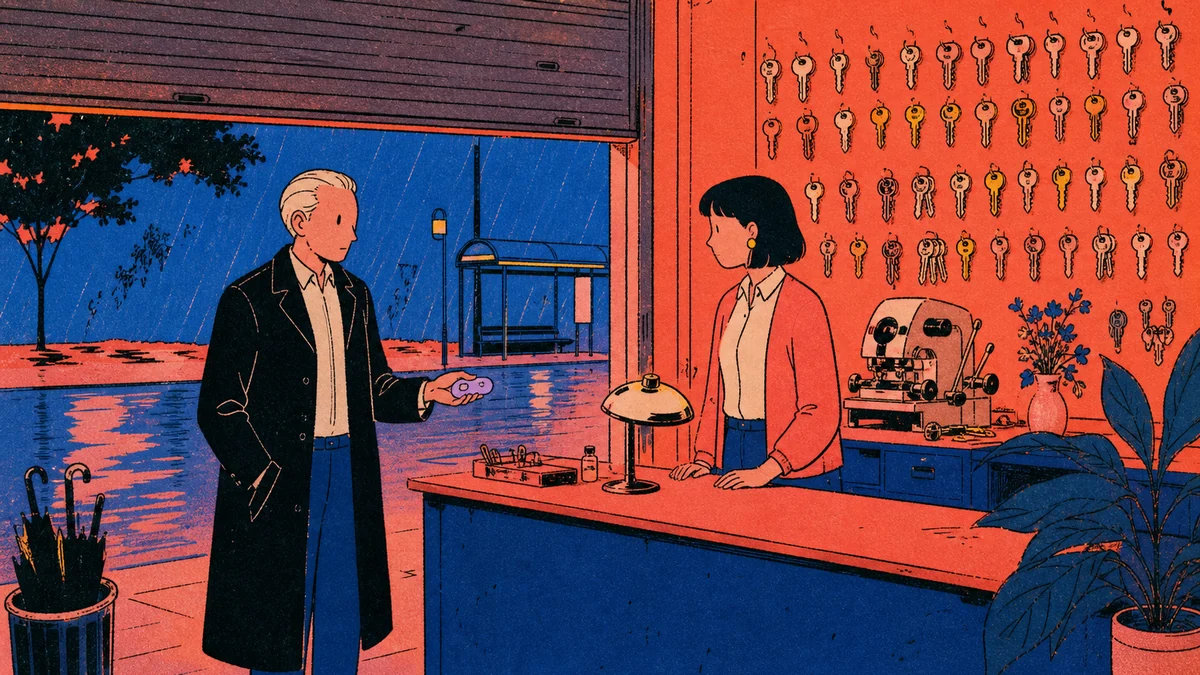
At nine fifty, an older man knocks on the grille. The last bus leaves in twenty minutes. He holds out a bar of hotel soap with the shape of a key pressed into it and asks Lena to make him a copy.
That is the situation. It becomes a story when Lena must decide whether to help him, and when the deciding shows us something neither of them could have said at nine forty-nine.
He says the key is his. Lena says most people who own keys bring the key. He says most people who own houses are allowed inside them. Then he studies the wall behind her, where hundreds of brass blanks hang from hooks like a choir that has been warned about shoplifting.
I do not yet know whether Lena makes the key.
This is useful. Instructions for short fiction can become too certain very quickly. Choose a character. Add a problem. Escalate it. Resolve it. There: the wild animal has been folded into a carry-on bag and placed in the overhead compartment.
Those instructions are not wrong. They are merely finished before the story has had a chance to become particular.
What makes a short story different from a novel?
A short story is brief fiction concentrated around a limited movement: a situation changes, a person notices or chooses, and the ending leaves the reader somewhere the opening could not. The exact length varies by publication and purpose. The more useful difference is that a short story cannot keep every interesting door open merely because the hallway is attractive.
A novel could follow the man's marriage, the house, Lena's apprenticeship, the person currently asleep behind the copied lock, and the consequences of whatever happens next. A short story can carry that larger world as pressure from outside the frame without visiting every address.
One rainy closing shift is a natural container. The grille is halfway down. The bus will come or it will not. Lena can make one key before the shop closes. Time and place begin trimming possibilities for us.
That does not mean every short story must happen in one room or one evening. Some cross decades in two pages. Some wander through several minds. Some barely contain what a workshop would call plot and still leave the reader altered. The form is short, not small-minded.
David Vann describes one tradition of the character-centered short story as a place where details refer back to the protagonist and the protagonist's problem. He also begins by saying there are no real rules and that a story should surprise its author. I like both claims better together. Focus gives the story somewhere to press. Surprise keeps the answer from arriving before the people do.
The live question here is not the theme, the moral, or the ending somebody could print on a mug. It is why this man needs this key tonight and what Lena risks by deciding for him. The short story does not have much acreage, but it can dig surprisingly deep if it keeps returning to the same unsettled patch.
This is where the essay on conflict as changed choices can help. Resistance matters because it alters what Lena can do next, not because the story is required to add a masked intruder before closing.
How to start a short story where something changes
To understand how to start a short story, establish just enough ordinary life for the break to register. Lena closes the same shop most nights. She knows the keys, the register, the grille, and the last bus. Tonight a stranger brings the shape of a key without the key itself.
The soap impression is unusual, but unusual is not enough. A purple horse in the shop would also be unusual and would create urgent questions about floor care. The key matters because Lena recognizes the request, understands the risk, and must respond before the bus comes.
She asks which lock it opens.
“Front door,” the man says.
“Whose?”
He rotates the soap in his palm. Lavender. A clean smell in a wet coat.
“Mine until April.”
The key belongs to a past tense. We now have divorce, eviction, foreclosure, estrangement, or a landlord changing the lock. Perhaps none. Perhaps he is lying. The story has opened several doors, which is slightly greedy for a story set in a locksmith shop.
I would not choose among them yet. I would ask what Lena notices. His cuffs are carefully buttoned, though rain has darkened the shoulders of his coat. His shoes are dry. He keeps checking the bus schedule. The bar of soap has a blue hotel name stamped into one corner. Lena recognizes the hotel across from the county hospital.
Some of those details may become important. One may remain a damp cuff. Short fiction needs concentration, but concentration is not the same as converting every object into an employee.
The peppermint matters because Lena has been there all day and because the wrapper refuses to release it. It may echo the man's problem if I am feeling pleased with myself. More likely it gives her fingers something to do while she decides whether to call her boss. I would be suspicious of a draft in which even the candy has completed leadership training.
The opening has done enough once the reader understands the ordinary pattern, the change, the person who must live with it, and why waiting is also a choice. You can explain the rest when the scene asks.
Does a short story need an outline?
No. A short story outline is useful when it settles the uncertainty that is preventing pages. It is optional when the scene already has enough life to lead you forward.
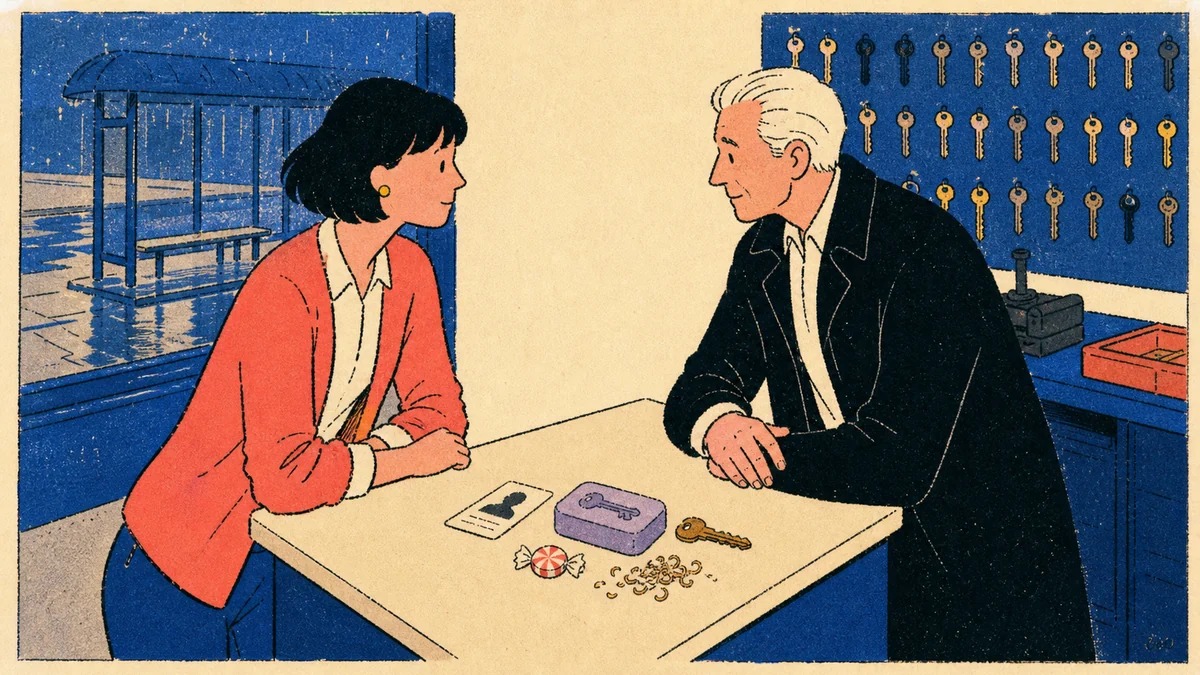
Lena asks for identification. The man gives her an expired driver's license. The address belongs to Weller Street, where several old houses still use the key blank pressed into the soap. She could not have known that before she looked. Now the draft has supplied its own next question.
If I became lost, I might write three questions in the margin: What makes Lena consider saying yes? What makes her pull back? What can she know by the time she must decide?
That is enough outline for this story. I do not need to decide whether the rain is the B plot. Another writer may need the final image first. Another may map each scene. Another may write the conversation until an ending appears. The outline should reduce the kind of uncertainty that stops the draft without eliminating the uncertainty that makes it worth reading.
The man sees Lena studying the license.
“You could have shown me this first,” she says.
“You would have said it was expired.”
“It is expired.”
“Then I saved us time.”
He is funny now, which is inconvenient. Suspicious people should have the decency to remain badly written.
A plan built from live questions also leaves room for characters whose choices change the route. If Lena becomes more coherent by refusing the key, the outline can move. It was a pencil mark, not a court order. The longer essay on novel outlines that allow discovery uses the same permission at a larger scale.
Short story structure can run, walk, or sit still
Ursula K. Le Guin argued against rules that mistake one useful story shape for the border of fiction. A story may run toward a climax. It may circle an image, move through rooms, gather voices, or sit very still while the meaning of a chair changes.
The chosen form still needs to teach the reader how to experience it. Lena's story promises a decision before closing. Repetition can work, but if five more customers bring five more strange keys, the pattern should deepen rather than behave like a sketch show whose locksmith has lost the will to live.
The helpful question is not “Am I allowed another scene?” It is “Does the new scene deepen the same movement, or has another story arrived with luggage?”
Suppose Lena goes home after refusing the man. In her kitchen she tells her sister what happened. The sister says she was right. Lena goes to bed. That scene confirms the first and gives everybody pajamas. It may not earn the trip.
But suppose she goes home and finds the hotel soap in her coat pocket. She did not put it there. The key shape is gone, rubbed smooth during the walk. Now the second scene changes our understanding of the shop. It may earn its light bill.
Showing and telling can both serve this movement. Stay in scene when Lena's hesitation, the man's answer, or the cutter's sound is the experience. Summarize the shop's history when a full scene would only make the reader renew parking. Le Guin's larger point about rules applies here too: a tool becomes foolish when it insists on being used for every repair.
The short-story writer chooses what kind of attention the form needs. The structure may be causal, associative, episodic, or quiet. What it cannot afford is movement that asks for our attention and then leaves the story unchanged.
How to write a good short story draft before editing
The first draft deserves permission to be wider than the finished story. The small form creates a nasty temptation to revise before anything exists. A writer keeps polishing the opening sentence because the rest is allegedly only six pages away. Six pages can be a very long distance when page one has set up a tollbooth.
Write past the clean version. Let Lena remember a customer who locked a baby in a car, then discover the memory belongs to a different story. Let the man explain too much about the house. Let a bus arrive and leave because it is the wrong route. A complete draft can show which moments exert force. A perfected opening can only become increasingly alarmed by page two.
This is also where the advice on dialogue shaped by different wants becomes useful. Lena needs enough speech to change her judgment. The man needs enough speech to get the key without explaining his life for our convenience.
She calls her boss. Voicemail.
The man says, “He won't answer.”
“You know my boss?”
“I know what time it is.”
The rain strengthens. The bus sign across the street turns blue in the wet. There is no bus yet.
Advice often says to raise the stakes. I hear that phrase and picture somebody inflating a small pool toy until the seam begins to whistle. This scene does not need a gun, a fire, or a secret order of locksmiths. It needs the existing choice to become more exact.
Lena recognizes the house number: 41 Weller. Last winter her shop rekeyed every exterior door after the owner died. The work order said the daughter lived out of state. It said nothing about the man in front of her.
He says the owner was his sister. There is a photograph inside of her at nineteen, holding a fish though she hated fish. The daughter is selling the house tomorrow and has refused to let him in. He does not say why.
There is the whole unwritten family, pressing against one copied key.
How do you revise a short story without cutting its life?
George Saunders often describes revision as a series of close, patient responses. A sentence feels false or generic; he makes it more specific; that specificity changes the character; the changed character alters the story. Revision, in that account, is one of the ways the story discovers what it is.
That feels especially right for short fiction. With fewer pages, a small change travels far. Give the man a plastic grocery bag instead of a leather briefcase and our judgment shifts. Make the hotel soap come from an expensive downtown place instead of the hospital motel and another story begins leaning on the door.
Cut the paragraph that explains what the scene already showed. Combine two neighbors who perform the same work. Remove the second clever line when the first one landed. But if you cut every pause, odd object, and unanswered gesture, the story may become a police report with excellent line breaks.
Compression should increase attention, not merely speed. Keep the detail that sharpens how this person sees, makes the room tangible, or changes under the ending. Cut the detail whose only defense is that you spent twenty minutes finding its adjective.
Then read the story without its explanations. Can you tell why Lena hesitates? Can you feel the bus nearing? Does the man become more specific without becoming fully solved? Does any paragraph announce what the reader already understood?
Revision may reveal that the story has the wrong center. Perhaps the man is only pressure and Lena's real problem is her faith in her own judgment. Perhaps the photograph matters more than the key. Perhaps the peppermint survives all three drafts through charm, bribery, or union representation.
Do not keep a cold draft alive merely because it is short enough to finish. The essay on returning to the live part of a stalled project can help when revision has become dutiful furniture moving.
How to end a short story after one earned turn
To understand how to end a short story, ask what can no longer mean what it meant at the start. An ending does not have to answer every question. It does need to reach the far side of the story's movement: something has been chosen, seen, refused, lost, or made impossible to ignore.
Lena could make the key. That is an action, but not automatically an ending. If she hands it over and the man leaves, the story may simply stop operating. The choice needs weight the opening did not yet possess.
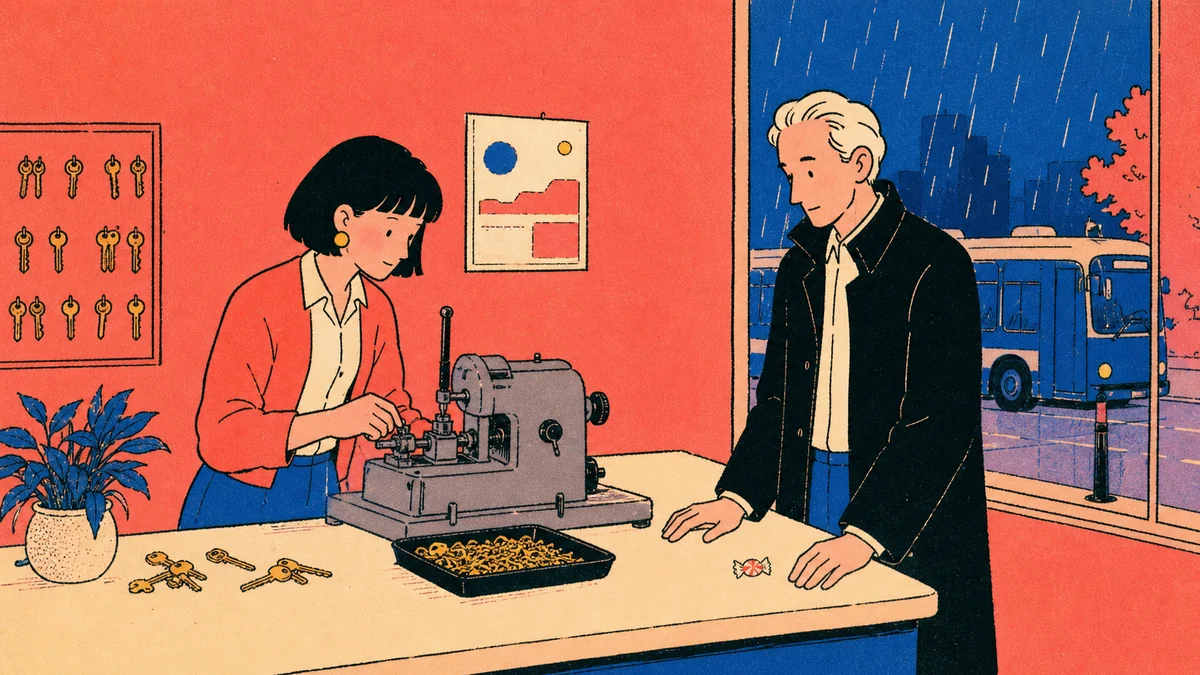
Lena finally frees the peppermint from its wrapper and offers it. The man takes it but does not eat it.
She puts a brass blank into the cutter. She has not decided to give it to him. The machine chatters, bright curls fall, and the man watches with his hands flat on the counter. The last bus turns onto the block.
Lena asks what his sister looked like at nineteen.
He says she wore her hair shorter than everyone remembers. He says she was holding a fish in the photograph, though she hated fish. He begins to laugh, quietly and unwillingly, at something he has not explained.
Lena sets the new key beside his expired license. The bus sighs at the curb.
I still do not know whether she slides it across.
The ambiguity works only if the story has made the undecided act meaningful. At the beginning, the key was suspicious hardware. Now it holds a stranger's claim about grief, trespass, family, and who is permitted to return. Lena's choice has not become easier. It has become hers.
That is enough change for a short story to end on. Another story could follow the man to Weller Street. This one belongs under the fluorescent light, in the second before Lena moves her hand.
Useful answers, briefly
Short story writing FAQ
How long should a short story be?
There is no single length that defines every short story. The form ranges from very brief fiction to work that approaches a novella, and magazines, contests, and awards set their own limits. Write the story to its natural size, then check the current rules of any place you plan to submit it.
Can a short story have more than one scene?
Yes. Add a scene when it changes, deepens, or complicates the movement already underway. If it only confirms what the previous scene established, summary or deletion may serve the story better.
Does a short story need a twist ending?
No. A twist is one kind of changed understanding, not a fee charged by the form. An ending may land through a choice, image, recognition, refusal, or shift in relationship as long as the story has prepared the change honestly.
How many characters should a short story have?
Use the people the story needs and be suspicious of duplicates. A small cast is often easier to deepen in limited space, but there is no moral victory in removing the person whose presence makes the room come alive.
Can a short story use multiple points of view?
Yes. Multiple viewpoints cost orientation and space, so each should alter what the reader can know or feel. If two viewpoints merely report the same movement, one may be enough.
How do you know when a short story is finished?
The story is ready for final revision when its central movement has reached an earned change and later pages would begin a different movement. Then check that the opening prepares the ending, the middle develops rather than repeats, and the remaining details deepen attention.
The rule of thumb
Choose one live situation. Stay long enough for the person inside it to see, choose, or lose something they could not at the beginning.
Keep the details that make the room human. Let the other stories knock tomorrow.
For now, Lena has one hand on the new key. Across the street, the bus opens its doors. The man puts the unwrapped peppermint in his pocket.
Write the next sentence.
Further reading
Sources
- David Vann via BookTrust (opens in a new tab) supported the character-centered focus on a protagonist's divided problem and the need for a story to surprise its author.
- Ursula K. Le Guin (opens in a new tab) supported the wider view of story shapes beyond one conflict-and-climax machine. Her essay On Rules of Writing (opens in a new tab) supported treating familiar craft rules as tools rather than laws.
- George Saunders (opens in a new tab) supported patient, iterative revision as a route to surprise and revising toward particular human behavior rather than generic explanation.