Story craft · Essay 08
What Is Conflict in a Story? It Changes the Next Choice
A closing pool, a doubtful ring, and one shark the story does not need.
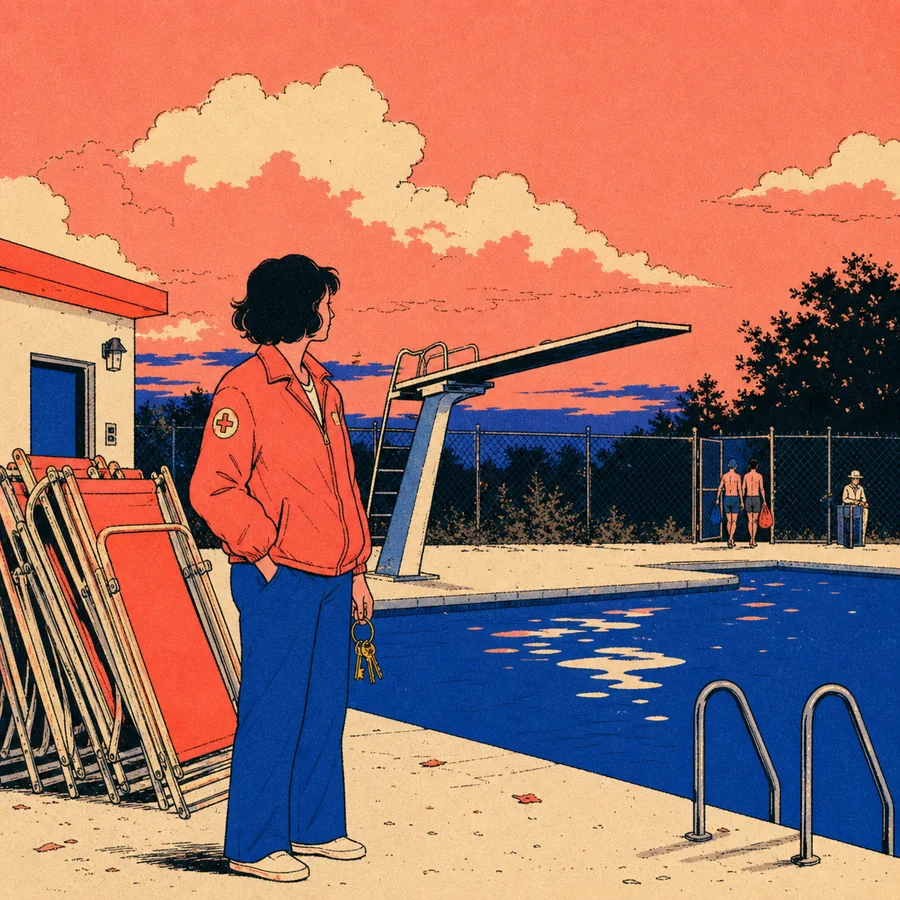
If a lifeguard needs more conflict, do not add a shark. The shark has no business in the municipal pool, and its paperwork alone will kill the chapter. If you ask what is conflict in a story, the plain answer is this: conflict happens when a character wants something, meets resistance, and can no longer make the easy next choice.
June manages the Bellweather Pool, a concrete rectangle with a crooked diving board and a vending machine that accepts dollar bills only after insulting them. Tonight is the pool's final night. The city will demolish it tomorrow, and a thunderstorm has arrived early to help with the paperwork.
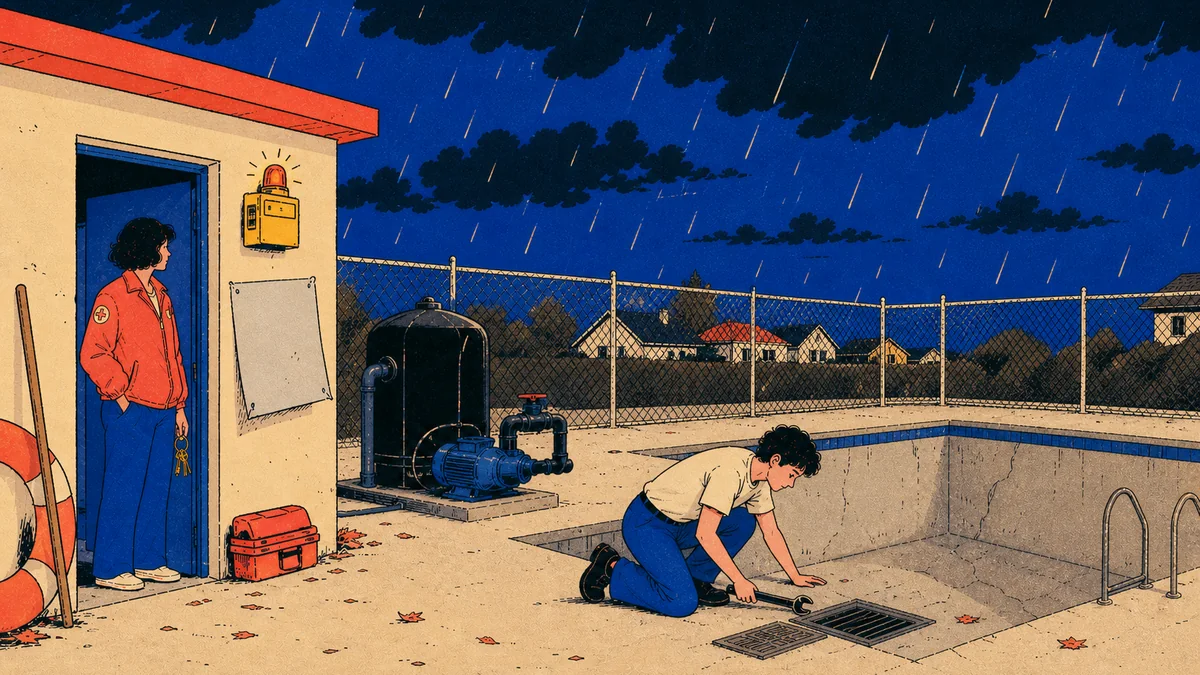
June has cleared the water. The lightning alarm is blinking. She needs to lock the gate before somebody gets hurt.
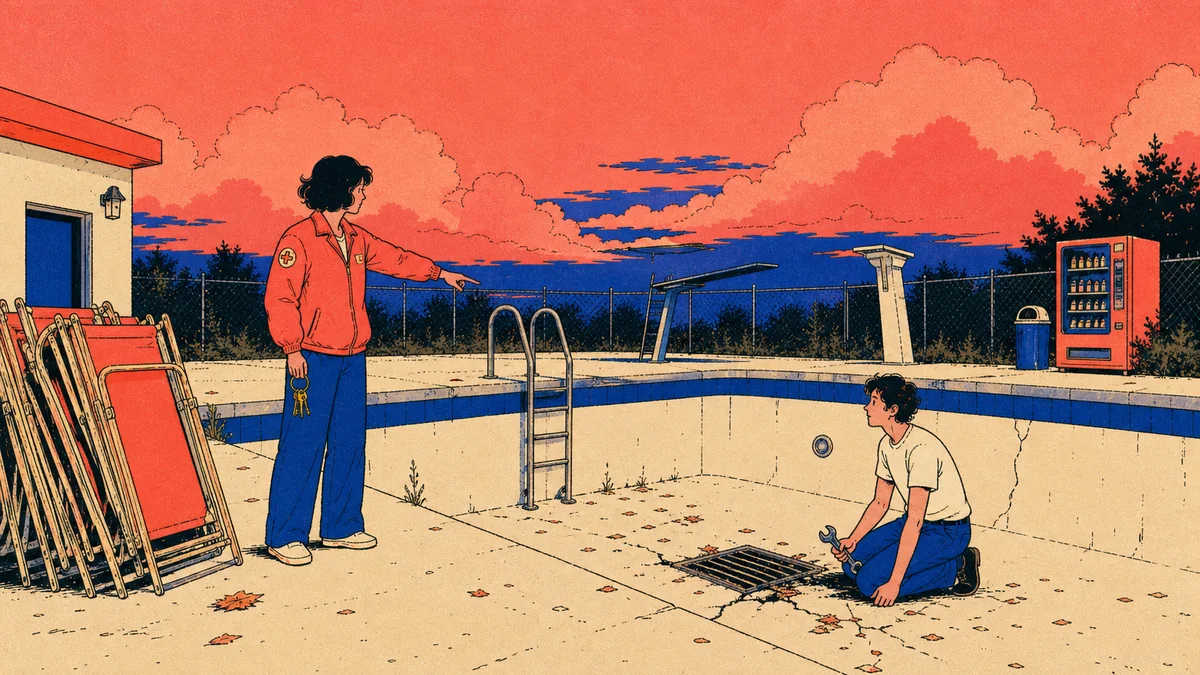
Her younger brother, Eli, is still in the drained deep end. He says their mother's wedding ring slipped through a cracked grate years ago, before she died, and he has come back with a borrowed wrench to find it. June thinks the ring story may be true. She also knows Eli improves a story whenever the truth looks underdressed.
The rain begins. June has the gate key. Eli has the wrench. Neither of them can leave with everything they want.
Why is conflict important in a story?
Conflict makes an action change the next available action. It turns a sequence of events into consequences.
June tells Eli to climb out. If he obeys, the scene ends and everyone can go home damp and mildly irritated. Instead, he removes the first bolt from the grate. Now June must decide whether to climb down, call the police on her own brother, cut the power before water reaches the pump controls, or keep arguing while the sky reloads.
The bolt matters because it closes some options and opens worse ones. That is why conflict is important in a story: it makes the future different from the past.
K. M. Weiland describes story conflict as an obstacle between a character and a goal. That is a useful starting point, especially if conflictmakes you picture two people throwing lamps. A locked door can oppose a character. So can weather, shame, a promise, a town ordinance, another person's equally reasonable plan, or the fact that the last bus left four minutes ago with magnificent indifference.
But not every obstacle earns a scene. If June's shoelace breaks while she walks toward the deep end, she has an obstacle. Unless the delay changes Eli's risk, exposes something between them, or forces a different response, it is just a shoe requesting attention.
A useful obstacle alters the route. It makes the character adapt, reveal a priority, pay something, or create a new difficulty. The story does not need constant disaster. It needs events that refuse to remain isolated.
Internal and external conflict meet at the same door
External conflict comes from outside the character: another person, a storm, an institution, a locked gate. Internal conflict happens when the character cannot satisfy two desires, beliefs, duties, or fears at once.
June's external problem is easy to point at. Lightning is approaching. The city's closure order is taped to the office window. Eli will not leave the deep end.
Her internal problem is quieter. She wants to keep her brother safe, but she does not want to treat him as the unreliable child he used to be. She wants to believe the ring is real. She also suspects that helping him search would be one more evening spent protecting a version of their mother that neither of them can retrieve.
The strongest internal and external conflict often lean on each other. The storm gives June no time to reach a clean emotional conclusion. Her doubt makes the practical choice harder than “lightning bad, gate closed,” a sentence even the vending machine could endorse.
Angela Ackerman distinguishes a villain from an adversarial force. A villain means harm. An antagonist is simply what opposes the protagonist's goal. That antagonist might be a loving brother with a wrench, a safety rule written for good reasons, or a sky behaving exactly as skies do.
Opposition does not require evil. In fact, conflict often becomes more interesting when both sides would sound reasonable if allowed to explain themselves without thunder.
What are the types of conflict in a story actually for?
The familiar types of conflict in a story include character versus self, character, society, nature, technology, fate, or the supernatural. The labels can help you notice where resistance comes from. They are less useful when treated like a grocery list for a balanced novel.
June versus Eli is person against person. June versus the closure order is person against society. June versus lightning is person against nature. June versus her suspicion is person against self. The pool pump makes a noise like a refrigerator reconsidering its life, so technology has filed an application too.
That does not mean the scene contains five separate conflicts. It means several forces are tightening one problem: Will June use her authority to end the search, or risk the storm long enough to help?
The labels are diagnostic. If a draft feels thin, they can reveal that all resistance comes from one snarling villain, or that the inner and outer stories never touch. Then you can adjust the living scene. You do not need to collect all seven like merit badges for having a difficult afternoon.
The same principle applies to a magic system whose limits create trouble. A limitation matters when it changes what a person can risk or choose. The category name is only a handle.
How to create conflict in a story without forcing it
Start by asking what each person is trying to protect, obtain, avoid, or preserve in this scene. Then put those wants in a space where they cannot all succeed unchanged.
Eli does not need to become reckless because the article requires friction. He believes the ring is beneath the grate because their mother told him she lost it at the pool. Finding it would prove that one of her disappearing stories had a solid bottom. He has also waited until demolition eve, which is exactly the sort of timing hope chooses when it wants to look suspicious.
June does not need to become a rigid official. She knows lightning can kill someone in an empty pool. She signed the closure sheet. She also remembers their mother sitting on the deep-end ladder after hours, bare feet in the water, turning a ring around her finger while she tried to decide whether to go home.
Now both characters carry something worth defending.
False conflict usually arrives when a writer withholds an obvious sentence, makes a sensible person suddenly foolish, or drops a random obstacle into the scene because the pace looked sleepy. The fix is not always a louder argument. Try making the wants more specific, the available time shorter, or the cost of a simple compromise visible.
If June says, “We can come back tomorrow,” Eli can point through the fence at the excavator. If she says, “Give me the wrench,” he can ask whether she wants the ring or merely wants him out of the hole. If he claims their mother promised the ring to him, June may remember a different promise.
Each answer changes the ground. This is also how dialogue gains subtext when speakers want different things. They are not trading information. They are trying to alter what happens next without naming everything it would cost.
Let conflict produce information. A good obstruction reveals a fact, loyalty, fear, resource, or mistake that the next part of the story must live with.
Conflict in a story examples show how tension grows
Conflict is the opposition itself. Tension is the reader's unsettled expectation about what that opposition may cause.
The grate can be stuck. That is conflict. Thunder can sound closer while June notices a rusted ladder bolt and calculates whether Eli can climb out quickly. That is tension. The reader begins measuring the distance between danger and decision.
You can have conflict with little tension. Two neighbors politely want the same parking spot, and one cheerfully backs away. You can also build tension before the conflict becomes visible: June sees a muddy shoe beside the locked gate before she knows Eli is below.
To strengthen tension, clarify what might change and delay the answer honestly. Do not merely hide information the viewpoint character already knows. Let the reader understand enough to worry in the correct direction.
June climbs into the shallow end. She does not agree to help. She says she is taking the wrench.
Then the pool lights go out.
The darkness does not make the conflict better by itself. What matters is that June can no longer see the ladder, the grate, or whether Eli has moved. The loss of light changes her next choice from an argument about memory to an immediate search for her brother.
That turn can guide a novel outline built from choices and consequences. When a section sags, look for the last action that should have changed the route but did not.
Does every story need conflict?
Most fiction contains resistance, difference, uncertainty, or incompatible desire somewhere. I would hesitate before turning that observation into a law requiring every scene to arrive armed.
Ursula K. Le Guin argued against treating conflict as the defining shape of all narrative. A story can gather, wander, observe, change scale, or hold people and objects in relation without behaving like a battle headed toward victory. Conflict may be inside that larger vessel without being its purpose.
That exception is not permission for a draft where nothing matters. It is permission to ask a better question than “Who wins?” A quiet story may move because a person notices what they had refused to notice. A relationship may change through care, embarrassment, discovery, or the gradual failure of an old assumption.
Change is broader than combat. If “add conflict” keeps making your scene false, look for difference with consequences: two people remember the same day differently; a guest stays ten minutes longer than expected; somebody accepts help and cannot return to the old distance afterward.
At Bellweather Pool, June finds Eli by touch. He is sitting beside the open grate, not trapped. In his hand is a cheap brass ring, green at the edges, too large to have belonged to their mother.
He says, “I thought there would be something.”
June could expose the lie. She could pretend the ring is real. Instead, she sits on the wet concrete until the emergency lights hum back on. The conflict has not vanished. It has changed from stopping Eli to deciding what kind of truth they can carry out together.
Useful answers, briefly
Conflict in a story FAQ
What is the main conflict in a story?
The main conflict is the sustained opposition that most strongly shapes the protagonist's pursuit through the story. It may involve another person, an institution, nature, or an inner contradiction. Smaller scene conflicts should usually complicate, redirect, or reveal some part of that larger struggle.
What are internal and external conflict?
Internal conflict occurs within a character when wants, beliefs, duties, or fears cannot all be satisfied. External conflict comes from outside the character, such as another person's goal, a social rule, weather, technology, or a physical barrier. They often work together rather than occupying separate chapters.
What are the main types of conflict in a story?
Common labels include character versus self, character, society, nature, technology, fate, and the supernatural. Use them to identify the source of resistance, not as boxes every story must fill. Several types may press on one central choice.
Can a story have conflict without a villain?
Yes. A villain intends harm, but conflict needs only meaningful opposition. Two decent people can want incompatible things, and a law, storm, distance, deadline, or private fear can block a character without becoming evil.
What is the difference between conflict and tension?
Conflict is the resistance between a character and what they want. Tension is the reader's anticipation of what that resistance might cause. Clear stakes, narrowing time, incomplete attempts, and changing options can increase tension without adding a fight.
Does every scene need conflict?
Not every scene needs an argument, danger, or dramatic reversal. A scene should create meaningful movement: a changed relationship, new knowledge, a committed action, a loss, or a sharpened question. If nothing is different afterward, the scene may need resistance—or may not need to be a scene.
The rule of thumb
Give the character a specific want, put something credible in the way, and make the attempt change the next choice.
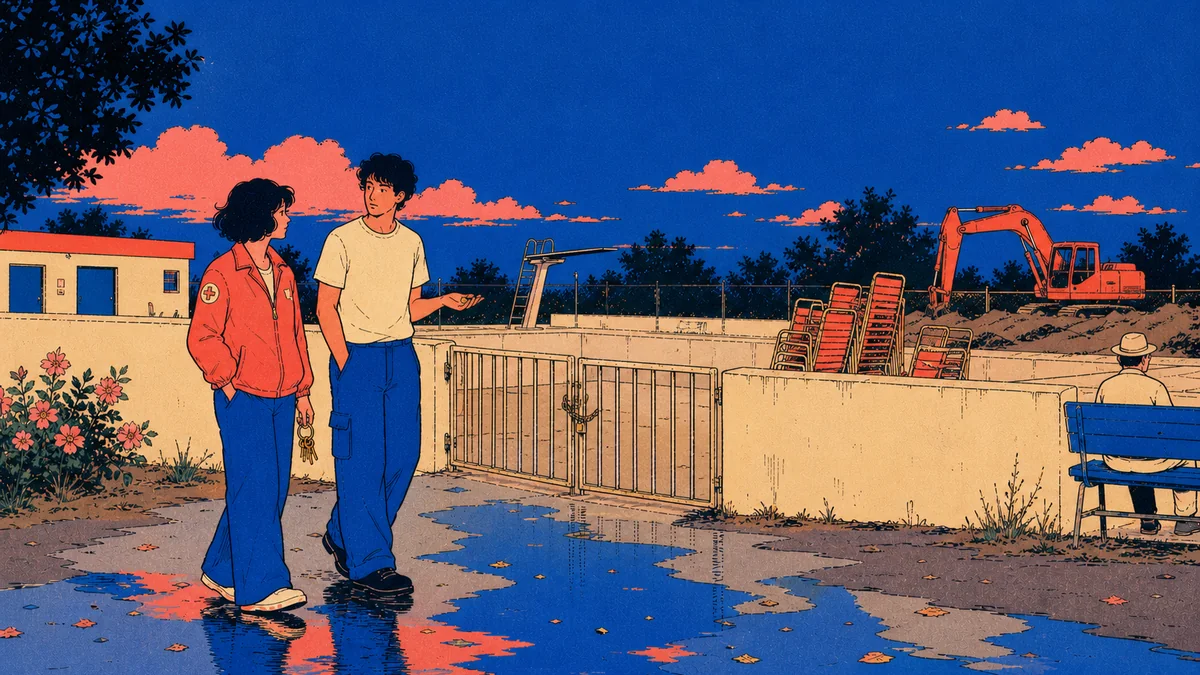
June locks the pool gate from the outside. Eli turns the brass ring in his palm. Neither calls it their mother's.
Behind them, the excavator waits in the rain, and for once no shark is asked to improve the evening.
Further reading
Sources
- K. M. Weiland (opens in a new tab) supported the goal-and-obstacle definition of conflict and its movement from story scale into individual scenes.
- Angela Ackerman (opens in a new tab) supported the distinction between villains, antagonists, and nonhuman adversarial forces.
- Ursula K. Le Guin (opens in a new tab) supported the complication that conflict may occur within a story without defining the whole shape or purpose of narrative.