Dialogue · Essay 04
How to Write Dialogue in a Story Without Making Everyone Sound Written
Give two people different hopes for the next five minutes, then let the language bend.

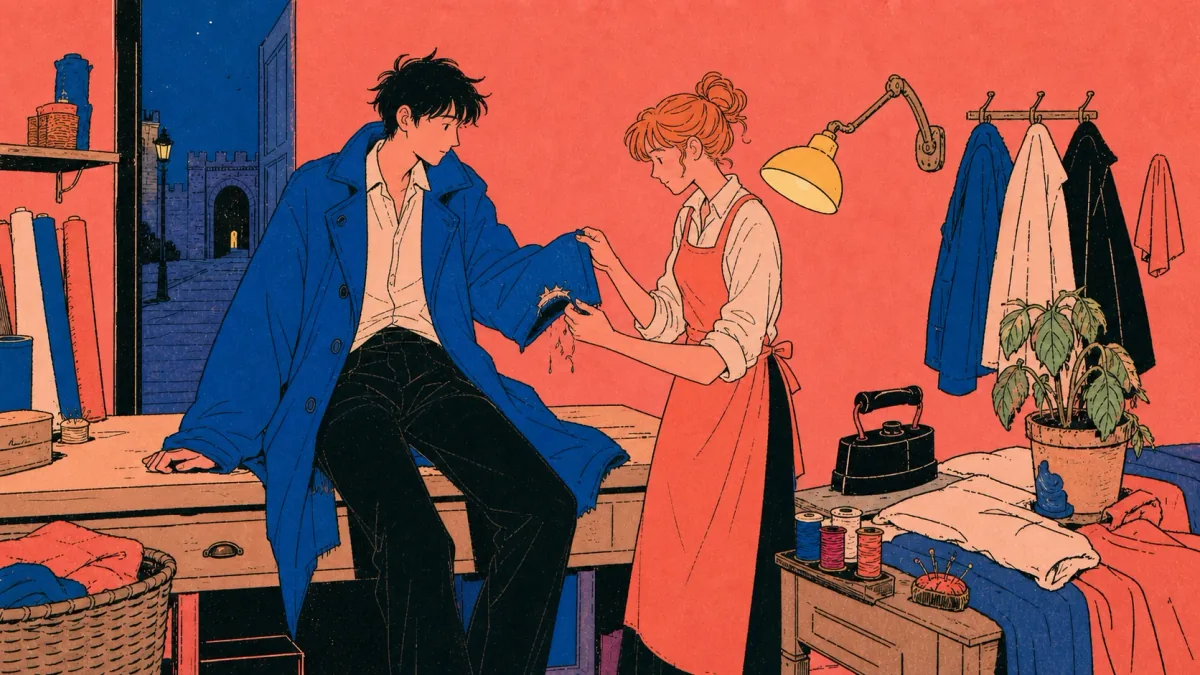
Lysa's brother comes to her repair shop after curfew wearing a stolen royal coat. Its sleeve is torn, and three silver burrs from the royal orchard cling to the cloth. He wants it mended before the guard arrives. Lysa wants him to tell her what happened.
If you want to know how to write dialogue in a story, start there: give two people different wants in the same conversation. Teren tries to escape each question. Lysa keeps asking. Their words matter because one of them is hiding the truth and the other is getting closer to it.
Dialogue goes wooden when characters merely exchange information. Give each person something they want now, cut the facts they both know, and make every line change the pressure between them. The words will sound alive because they have something to do.
How to write natural dialogue without copying real speech
Natural dialogue is not literal speech. It is speech with its shoes tied.
The writers on Writing Excuses describe it as a middle ground: inaccurate in the small ways that make it feel accurate. The repetitions thin out. The greeting happens offstage. The interruption arrives where it has the most force, not three words after the speaker became annoyed. We still hear hesitation, rhythm, and attitude, but we do not have to stand there while everybody finds their keys.
The easiest way to find that middle ground is to stop asking, “Would a person say this?” Plenty of people would say almost anything if trapped in a long enough meeting. Ask instead: Would this person say this, to this listener, right now?
Lysa repairs courier coats in a narrow shop near the west gate. The coats are dark blue, stiff at the collar, and stitched with moth-silk thread that catches the gate lanterns. A royal courier wearing one may pass through the city after curfew. That makes a torn coat more than laundry with ambition.
Her mother has also given her a basil plant, although “given” is generous. The pot appeared on the sill one Tuesday with instructions. It is now mostly a collection of brown stems that Lysa waters out of guilt.
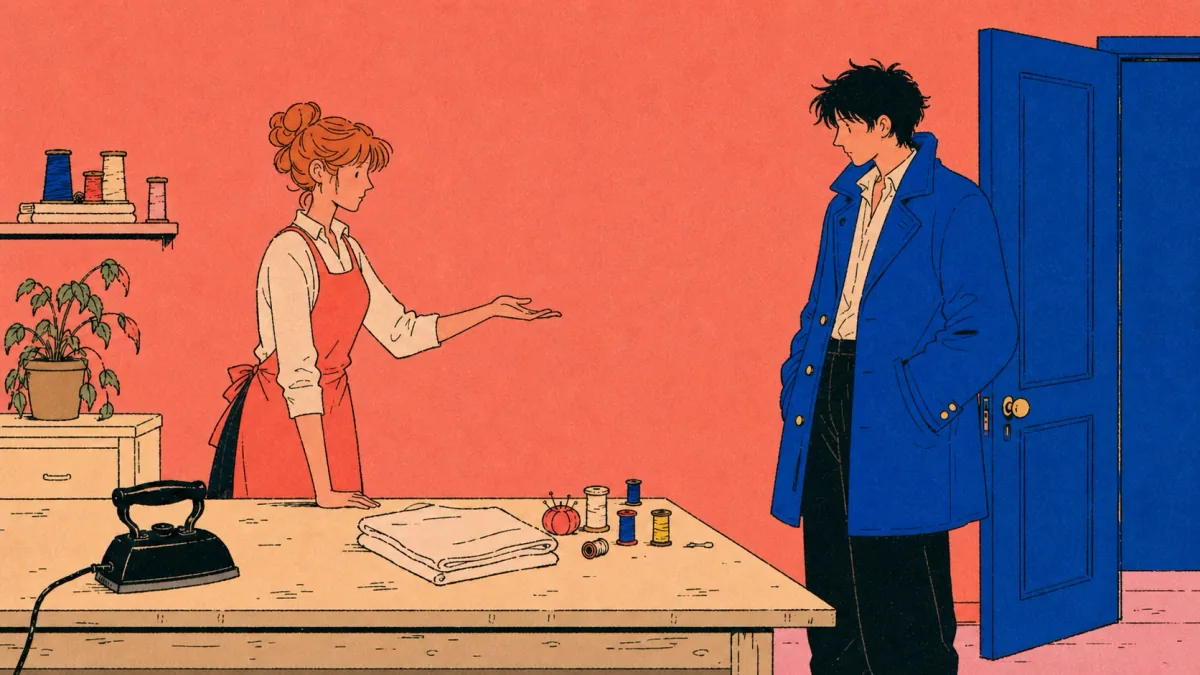
Lysa is banking the charcoal under her iron when her younger brother, Teren, shoulders through the door. The bell above it gives one damp clunk. He is wearing a courier coat that does not belong to him.
There is a tear beneath the right sleeve. Three silver burrs cling to the wool.
“I need this mended,” Teren says.
Lysa turns the coat toward the lamp. “You need several things.”
“Can you do it?”
“Before or after the palace guard asks why the royal orchard is stuck to your armpit?”
They do not greet each other. Teren does not explain what a courier coat is. Lysa does not announce that the silver burr grows only in the forbidden orchard because both of them already know. The scene gives the reader enough physical evidence to catch up without making either sibling conduct a guided tour.
Teren answers a question with a question. Lysa turns tailoring into accusation. Neither delivers a complete position statement because neither came here to explain himself to us.
That does not mean the reader should remain lost. The narration has already supplied the shop, the curfew privilege, the tear, and the burrs. Concrete context lets the dialogue become quick and partial. Without that footing, the same exchange would be two voices fencing in a dark cupboard.
What is each line trying to change?
Mary Robinette Kowal offers a useful test on Writing Excuses: every line has an authorial reason and a character reason. The author needs the line because it changes the scene, reveals a fact, tightens a doubt, or sets up what follows. The character needs the line because they are trying to get something.
These reasons can overlap. They should not be identical.
I need Teren to tell Lysa the captain is coming. Teren does not care what I need. He wants the coat repaired before the captain sees it.
“How long?” he asks.
“For the sleeve?”
“For all of it.”
Lysa plucks one silver burr free. “Who is looking for you?”
The bell above the door gives another useless clunk.
“Captain Venn is making rounds.”
“That was almost an answer.”
The captain gives the scene a deadline. Teren mentions him because he wants speed to feel more urgent than explanation. Lysa refuses the trade.
When dialogue feels wooden, one of these reasons is often missing. A character recites lore because the author needs it. Two people trade jokes because the author wants sparkle, though neither has reason to be funny. Or the character has a plausible reason to speak, but the line does no work in this scene. Real people tell the same story about a delayed flight three times. Fictional people may do that too, but the third telling had better bruise somebody.
Try reading a weak exchange one speaker at a time. Ignore the replies. What is this person attempting with each line—delay, soothe, embarrass, threaten, recruit, test, forgive? If the answer is “deliver Chapter Four information,” you have found the loose floorboard. The character needs a reason that would still matter if no reader were watching.
Teren glances at the basil plant. “Mother says you don't come to supper because you're busy.”
Lysa pulls the thread until the knot disappears into the seam.
“Mother says many things.”
The line is unfair in several directions. Teren watches her work. For a moment, the coat is just a coat again, and Lysa wishes he had kept it that way.
How to write subtext in dialogue without turning it into fog
Subtext is what the speakers mean, fear, suspect, or want without placing it neatly in the sentence. It does not require everyone to speak in riddles until the furniture loses patience.
The Center for Fiction recommends economical dialogue partly because cutting the extra sentiment leaves more room for implication. I would add one caution: something on the page still has to carry the meaning. The reader can infer. The reader should not have to perform a séance.
Lysa sets the coat on her worktable.
“Take it off,” she says.
Teren does not move.
“I can mend wool,” she says. “I have had less success with brothers.”
“You said you wouldn't ask.”
“I haven't.”
Now the coat matters in two ways. Teren needs it repaired, but removing it would expose whatever he is hiding beneath it. Lysa's request is practical and investigative at once. His refusal tells her more than a confession would, though neither names the injury.
Eventually, somebody may need to say the direct thing. If Teren is bleeding, Lysa cannot spend twelve pages asking whether he finds the room unusually red. Subtext creates tension because truth is costly, not because truth has been banned from the premises.
Perhaps she cuts the coat open and finds no wound. Instead, there is a folded map sewn into the lining.
“You could have knocked,” Teren says.
“You did knock. With stolen government property.”
The joke releases a little pressure. Lysa now knows he entered the orchard deliberately, and Teren can no longer pretend this is a tailoring job.
She folds the map once and pushes it back at him. Teren tucks it beneath his shirt.
Good subtext keeps moving. A character dodges, the other notices, and the next line carries a different understanding even if nobody has left the room.
How to make characters sound different to different people
The usual advice is to give each character favorite words, sentence lengths, and verbal habits. That can help. It can also produce a cast in which one person says “indeed,” one person drops every final g, and one unfortunate soul has been sentenced to mention turnips until the epilogue.
Voice begins deeper than decoration. Different characters notice different dangers, make different assumptions, and use speech for different kinds of control.
Lysa speaks precisely because precision is how she works. She names the damaged seam, the silver burr, the answer Teren has avoided. Teren speaks by narrowing the question. He wants only the repair, only the time, only the next five minutes. Their rhythms come from their methods.
Then Captain Venn knocks.
Teren mouths, “Don't.”
Lysa opens the door.
“Late work?” the captain asks.
“Poor work,” Lysa says. “The palace has started sending me crooked seams.”
“We're looking for a courier.”
“Then the crookedness may be more serious than I thought.”
Lysa does not speak to the captain as she speaks to Teren. Her sentences become formal. She hides insults inside professional concern. With her brother, she cuts straight toward the bruise because intimacy has already paid the entrance fee. Same character, different listener.
The 2023 Writing Excuses dialogue episode makes this point directly: swap the person being addressed and the dialogue should change. Status, trust, history, attraction, fear, and shared knowledge all alter what can be said. A guard talks differently to her commander, her prisoner, and the friend who remembers when she fainted during goat judging.
If every character sounds alike, resist buying each one a catchphrase. Write a short exchange in which they all want the same object. Who asks? Who assumes it is theirs? Who makes a joke because wanting it feels dangerous? Who never mentions the object and moves closer to it while talking?
That is voice with its hands attached.
How do you use dialogue tags and action beats?
Dialogue tags tell us who spoke. Action beats show a character doing something around the speech. They can identify the speaker too, but that is not their only job.
“I didn't enter the orchard,” Teren said.
Clear. Nothing wrong with it.
Teren pushed the silver burr beneath Lysa's cutting mat. “I didn't enter the orchard.”
Now his body has voted against his sentence.
Use said when the reader needs a signpost and the line deserves the attention. Use an action beat when movement changes pace, reveals feeling, clarifies the room, or creates subtext. Do not replace every “said” with a person sipping, nodding, shrugging, turning, and examining nearby curtains. Eventually the cast resembles an amateur mime troupe trapped in a coffee shop.
The Writing Excusesepisode on blocking and description recommends establishing concrete geography before asking dialogue to carry the scene. Lysa's table sits between Teren and the back door. The hot iron is near her hand. Captain Venn stands at the front. Once we know that, a glance or step can matter without an architectural update between every line.
“May I see the coat?” the captain asks.
Lysa lays her palm over the torn sleeve. The iron breathes beside it.
“Tomorrow,” she says.
Teren shifts toward the back door.
The captain glances at him. “Your assistant?”
“My brother.”
“That was not the question.”
Teren takes his hand off the latch.
Once the exchange accelerates, remove some beats. Readers do not need the characters repositioned after every sentence. Give the room a floor, let the people stand on it, and trust the words to run.
How do you edit dialogue without sanding it flat?
The first dialogue draft may be too long, too clear, or strangely courteous. Fine. Let the characters get the information onto the page before you make them sound as though they have known each other for twenty years.
The older Writing Excuses episode on stilted dialogue suggests writing the needed exchange and pruning it afterward. It also recommends turning exposition into argument, correction, or recollection. People are more likely to mention a shared fact when they disagree about what it means.
Suppose the first draft reads:
“You know Father died in the royal orchard,” Lysa said.
“Yes, I know that Father died there ten years ago when we were children,” Teren replied.
“That is why I am upset that you went there.”
The facts are useful. The siblings have been replaced by two plaques in a small museum.
Try again:
“You went where he died,” Lysa says.
Teren looks at the scorched edge of the map. “He died outside the wall.”
“His body did.”
The history can enter because they disagree about it. Lysa thinks the orchard killed their father. Teren thinks the distinction matters. The exchange has lost words and gained a door.
Read the whole scene aloud. Your mouth will find furniture your eyes politely walked around. Cut the greeting that only starts the scene. Cut names used by people who know whom they are speaking to. Cut the first answer if the second answer is where the character stops being careful.
Then check the lines you love. A bright retort may be lovely and wrong for the person saying it. Not everyone becomes Oscar Wilde when cornered near an iron. Some people become repetitive. Some go formal. Some answer the safest part of the question and hope the dangerous part becomes distracted.
Keep the line that belongs to the character, even when the cleaner line belongs to the writer.
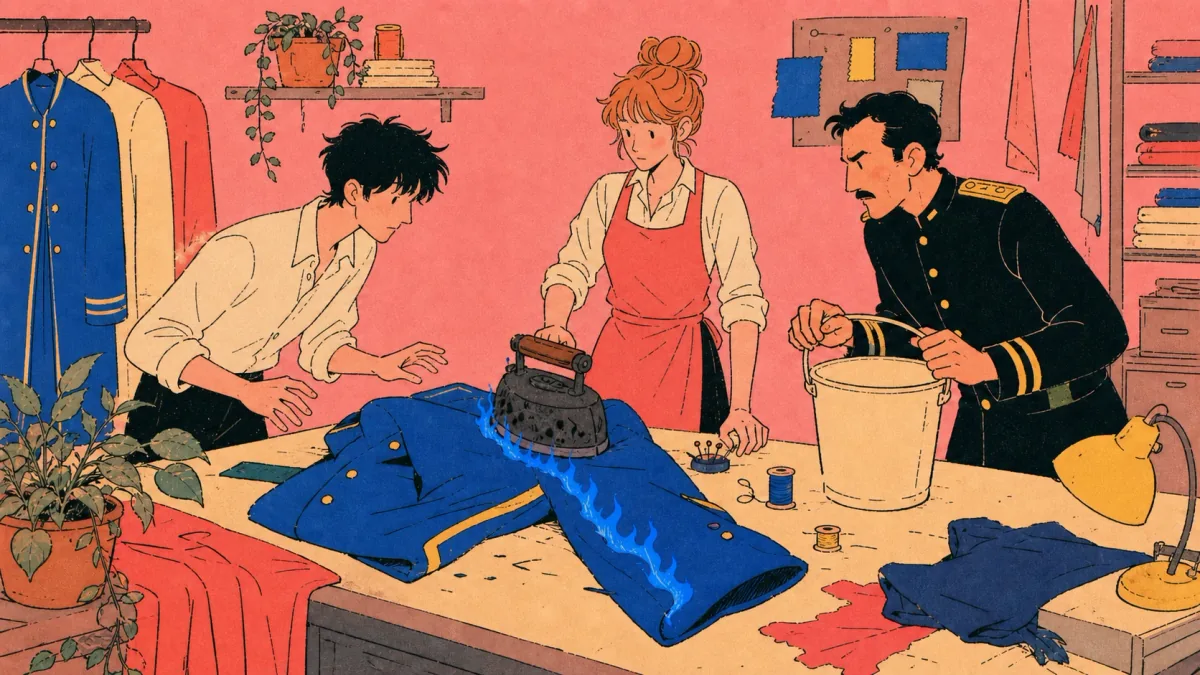
Captain Venn reaches for the coat. Lysa could deliver a flawless speech about loyalty, law, and family. Instead, she tips the iron.
It lands face-down on the sleeve.
The moth-silk catches first. Blue flame travels along the royal seam, neat as a line of handwriting. Teren says her name. The captain swears and grabs the water bucket. For three useful seconds, nobody is eloquent.
Afterward, the captain has a ruined coat, Lysa has an angry brother, and Teren still has the map beneath his shirt. The conversation did not solve everything. It forced everyone to choose a next move.
That is enough work for one scene.
Useful answers, briefly
Dialogue writing FAQ
How do I make dialogue sound natural?
Write the feeling of conversation rather than a transcript. Keep the interruptions, partial answers, rhythm, and attitude that reveal the speakers, but cut routine greetings, repeated information, and filler that does no work in the scene.
Should I always use “said” in dialogue?
No, but “said” is useful because readers barely notice it. Use a precise speaking verb when delivery truly changes the meaning, and use an action beat when the character’s movement adds pace, physical context, or subtext.
How do I punctuate dialogue in a story?
In common U.S. fiction style, spoken words take quotation marks, a comma usually separates speech from its dialogue tag, and each new speaker begins a new paragraph. Action beats are separate sentences, so punctuate them as actions rather than as speech tags. A publisher’s house style may differ.
How do I make two characters sound different?
Give them different priorities, assumptions, relationships, and ways of trying to get what they want. Vocabulary and rhythm matter, but the strongest distinction is often what each person notices, avoids, or believes can be said to this particular listener.
How much dialogue is too much?
There is no useful universal percentage. A long exchange works when the reader can follow who is speaking, where the bodies are, what each person wants, and how the conversation changes. Add narration or action when the voices begin to float free of the room.
What is the best way to practice writing dialogue?
Write a short exchange in which both speakers want different outcomes, then read it aloud. On the second pass, cut the greetings, replace one explanatory line with disagreement, and swap one spoken line for an action that reveals what the character will not say.
The rule of thumb
Before keeping a line, ask what the speaker is trying to make the other person do next.
They may want an answer, forgiveness, silence, the back door, or ten minutes alone with a stolen coat. If the line changes nothing and reveals nothing, let it go. Your characters can discuss parking after the book is over.
Lysa watches the blue fire crawl up the sleeve. The repair will not be ready tomorrow.
For once, everyone in the shop believes her.
Further reading
Sources
- Writing Excuses (opens in a new tab) supported the distinction between literal and convincing speech, the two reasons behind every line, relational character voice, and the role of nonverbal context. Its episodes on avoiding stilted dialogue (opens in a new tab) and combining dialogue, blocking, and description (opens in a new tab) supported the revision and scene-grounding sections.
- The Center for Fiction (opens in a new tab) supported dialogue as character, action, masked exposition, and subtext, along with economical speech and unobtrusive tags.
- Writers.com (opens in a new tab) supported the general U.S. fiction punctuation conventions summarized in the FAQ.