Story craft · Essay 17
How to Write a Novella That Deepens Without Sprawling
One overnight caller, a shelf of old tapes, and a story that gets deeper without renting another continent.

Ana's overnight radio show has one caller, one locked studio, and enough backstory slips to violate the fire code. If you want to know how to write a novella, choose one meaningful change that can deepen without multiplying: a focused cast, a limited span, and a central trouble that keeps revealing new consequences. A novella needs more room than a short story, but it does not need to arrive wearing a novel's coat with the sleeves stapled up.
At 1:14 a.m., the caller asks Ana to play an old song. The request is ordinary until he signs off with a phrase Ana and her younger sister, June, invented as teenagers: Keep the porch light tuned. June has not spoken to Ana in eleven years.
Ana hosts Night Weather from a community station above a closed pharmacy. She reads marine forecasts, takes calls from insomniacs, and plays music selected by a computer with the emotional range of a grocery-store freezer. Her producer, Ben, works behind the glass. The ON AIR sign has faded to ON AR, which sounds less like broadcasting and more like a pirate reconsidering his career.
There is your novella-sized possibility. One host. One producer. One caller who may or may not be June. One room through the remaining hours before dawn. The story could become a short story if Ana answers the call, learns one thing, and makes one sharp choice. It could become a novel if the caller leads her across three states, into the station's ownership dispute, through June's marriage, and somehow into municipal corruption. City hall is always available when a plot needs to gain twelve pounds.
What does novella word count actually tell you?
A novella is fiction longer than a short story and shorter than a novel, but no single number governs every shelf. The Nebula Awards use one clear boundary for their science fiction and fantasy categories: at least 17,500 words and fewer than 40,000. A publisher, magazine, contest, or genre may draw its line elsewhere.
That makes novella word count useful for a specific submission or publishing decision. It is less useful as a story diagnosis. A manuscript does not become a novella because it reached 17,500 words with the help of a prolonged breakfast.
Word count classifies; scope shapes. A novella usually carries fewer major relationships, locations, plotlines, and transformations than a novel. It has enough space for a central trouble to change meaning several times, which is more room than many short stories want.
The draft may find its honest length before you find its label. If you are deciding between forms, a short story concentrates attention around one changing situation, while a novel can support more lines of consequence. The novella sits between them without being a consolation prize for missing 80,000 words.
How do you find a novella structure that can deepen?
Begin with a question the story can revisit. Not a premise that produces one surprise, and not a premise that must branch into six plots to stay alive. A question with layers.
Is the caller June? That might get us through a short story. Why did June leave, what does Ana believe happened, what does the caller want her to say on air, and what would answering cost now? Those questions do not add unrelated machinery. They deepen the same relationship.
This is the part “keep it simple” tends to miss. Simple can sound like a command to remove everything interesting. A focused novella structure should not feel malnourished. It earns depth by returning to the same trouble after the reader knows more.
The caller phones again at 2:03. This time he knows Ana used to fake weather reports into a cassette recorder while June made thunder with a cookie sheet. Ben can hear only Ana's side because the station's recording system stopped saving incoming audio last winter and now serves mainly as an expensive clock.
The second call changes the first. Maybe this is June using a voice changer. Maybe somebody found the sisters' tapes. Maybe Ana has lied about why they stopped speaking. The story has moved without hiring a new villain, opening a second timeline, or placing a coded message inside a lighthouse.
Each return should alter the available choice. A character learns something, loses an easy option, acts on a mistake, or discovers that the original question was too small. Repetition with changed meaning builds accumulation. Repetition without change is the same conversation performed in a different chair.
Conflict works when it changes what the character can choose next. A novella can keep one central conflict while allowing its emotional and practical consequences to spread.

What belongs in a novella outline?
Freya Marske has described carrying the familiar bones of her novel-planning method into a novella while reducing the space between major events. Paul Michael Anderson writes toward sensory and emotional moments he can already see. Both approaches make sense for writers who like a map.
If maps cause you to immediately found a transit authority, keep yours lighter. A novella outline can record the disturbance, the midpoint change in understanding, the choice that cannot be taken back, and the ending's emotional destination. Leave room for the roads between them to move.
Ana's rough map might contain four lines. A caller uses June's private sign-off. Ana learns that old tapes have been airing on an unused frequency. Ben admits he found and digitized the tapes while repairing the archive. Ana must choose whether to play one publicly before the station signs off at dawn.
That is enough to expose problems without notarizing the book's future. If Ben is secretly the caller, the mystery may collapse into a prank with unusually expensive emotional consequences. If June is listening, why does she need the broadcast? If nobody knows, the story may keep that uncertainty but still needs an irreversible choice from Ana. Ambiguity is allowed. Vagueness is ambiguity wearing sweatpants.
For a longer look at exploratory planning, a novel outline can leave room for character discoveries. The scale differs, but the useful question survives: does the plan help you see choices, or merely make the unwritten story look obedient?
How should novella structure handle cast and pacing?
The compact cast helps when each person has more than one relationship to the trouble. Ben is not merely the producer who supplies information. He has spent years hearing Ana mention June only as a correction to some other memory. He digitized the tapes because the archive was molding, not because the outline hired him to be suspicious. He may believe he saved something. Ana may hear theft.
This is where combining characters can help. If the engineer, archivist, best friend, and station manager each appear for one useful scene, consider whether Ben can perform two of those jobs without becoming the Swiss Army knife of public radio. A compact cast creates recurrence. The same person who helps in one scene can disappoint in another.
Keep the central relationship under pressure. Character depth does not require a full biography. It requires the present action to disturb more than one layer. Ana wants to identify the caller. She also wants to keep her public voice steady, preserve her version of the past, punish June without admitting she still waits, and finish the forecast because a shrimp boat named Mild Concern has requested the offshore wind.
That boat may remain only a joke. Restraint includes allowing a thing to pass through the story without handing it a symbolic badge.
Do not cut people solely because an online guide gave the novella a maximum occupancy. A crowded family table may be the whole form. Multiple viewpoints may be precisely what a story needs. Ask whether each addition bends toward the central change or begins asking for a separate book and a better parking situation.
If a character feels broad but not deep, character development becomes visible through continuity and changed choices, not through another page of profile answers.
Let the pace leave room for life
One night in a radio studio gives Ana's story natural compression. The deadline is sunrise. The callers, weather, and shifting music keep the room from becoming a beige box. But a novella does not have to stay in one place, use one viewpoint, or move quickly. It can cross years if each jump keeps returning to one relationship, place, or transformation.
Fast is not the same as dense. If every scene sprints to the next plot point, the reader may understand what happened while feeling that nobody lived through it. Let Ana clean pencil dust from the soundboard while the unanswered line blinks. Let Ben microwave soup that smells like a wet cardigan. Let the marine forecast continue because boats do not suspend their plans for family estrangement.
Those details do not all need to become clues. They give the central trouble somewhere to happen. The novella's economy comes from details doing several quiet jobs at once, not from evicting every chair that does not advance the plot.
At 3:40, Ana plays a recovered tape off-air. Fifteen-year-old June predicts a storm. Young Ana interrupts to correct the wind direction. They argue, laugh, then repeat the sign-off together.
Present-day Ana stops the tape before the laugh. Ben notices.
Now the story has an emotional turn. Ana's grievance may be accurate and incomplete. June may have abandoned her after their mother died. Ana may also have turned every shared memory into a forecast she alone was qualified to correct. The novella can hold that contradiction because it has not spent its room introducing the mayor's secret radio tunnel.
Pacing is partly the distance between changes. What did the character believe entering a section? What can they no longer believe when it ends? If nothing changes, perhaps the section is atmosphere the story genuinely needs. If three sections in a row are atmosphere, the novella may have opened a spa.

How do you revise without padding or crushing the story?
Revise first for recurrence. Track the people, places, objects, promises, and questions that return. Each return should add meaning or consequence. The ON AIR sign is background at first. Later, Ana may be unable to confront Ben because the microphone is live. At the end, the sign going dark may feel like relief, defeat, or the first private minute she has allowed herself all night.
Then track what appears once and demands attention. A cousin with three pages of backstory, a robbery that never changes Ana's choice, and an entire subplot about the pharmacy downstairs may be good material. Good material is not a diplomatic passport. A strong scene can still travel in the wrong book.
Cutting is only half of revision. A thin novella may need expansion, but expand inward before adding outward. Add the scene where a choice becomes harder. Let the aftermath last. Return to an object after its meaning changes. Give the important relationship enough ordinary life that its fracture matters.
If Ana hears the sign-off and immediately forgives June, the story may be emotionally undercooked. If she spends six chapters locating the inventor of the voice changer, it may be cooking a different meal. A useful added scene might be quieter: Ana records a reply, deletes it, then realizes the station's delay system preserved seven seconds of a voice she thought was lost.
That adds consequence without adding a continent.
If the draft reaches its honest ending at 9,000 words, do not install a breakfast subplot to qualify for a nicer label. If every meaningful choice opens two independent relationships and another timeline, let the project grow. The difference in novella vs novel is not merely that one manuscript stopped sooner. A novel often wants breadth. A novella wants enough room to revisit but not enough obligation to tour.
Useful answers, briefly
Novella FAQ
How long should a novella be?
It depends on the market and genre. The Nebula Awards define an eligible science fiction or fantasy novella as 17,500 to 39,999 words, but other publishers and categories use different boundaries. Check the specific destination before revising toward a number.
How many chapters should a novella have?
There is no required chapter count. Divide the story where time, place, viewpoint, knowledge, or emotional direction changes enough to give the reader a useful pause. A novella may use many short chapters, a few parts, or no chapters at all.
Does a novella need an outline?
No. A light map can protect the story's scope, especially if you know a few important turns, but discovery writers can draft toward questions and revise once the shape appears. The outline should help the story move, not make uncertainty illegal.
Can a novella have subplots or multiple points of view?
Yes. The form can hold either when they intensify the central change rather than opening unrelated books inside it. Add them because the story needs another angle or consequence, not because novels usually have them.
Is a novella easier to write than a novel?
Not automatically. It is shorter, but compression makes every major scene and relationship more visible. A novella may take less time to draft while demanding sharper choices about what belongs.
The rule of thumb
Write down three returns to the same trouble.
At each return, change what the central character knows, wants, risks, or can still choose. If you have only one honest turn, the idea may want a short story. If every return opens a separate plot, it may want a novel.
At 5:48, the caller phones again. Ana has stopped trying to prove the voice belongs to June. She asks one question she has avoided for eleven years: “Were you listening the night I told everyone she left?”
The caller says yes.
That answer does not identify him. It changes what Ana must do. At 5:59, she opens the microphone. She reads the marine forecast, including the wind correction June used to tease her about. Then she says the old sign-off once, without explaining it.
The ON AIR sign goes dark. Ben reaches for the archive drive. Ana puts her hand over it—not to take it, not yet.
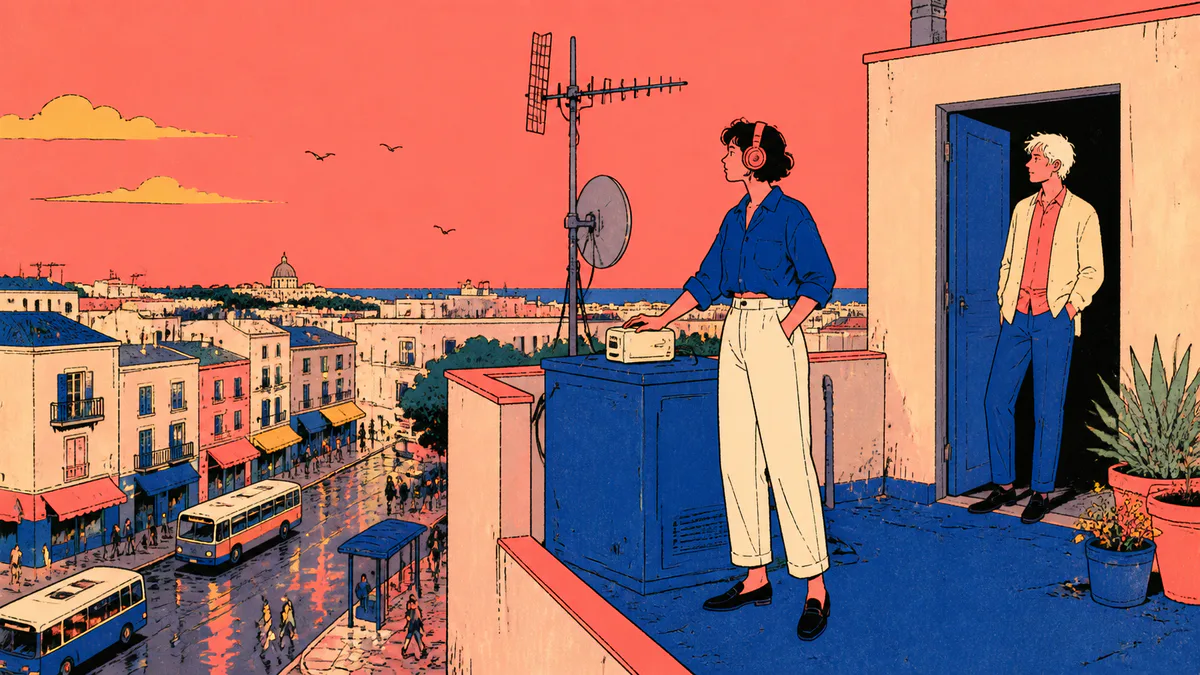
Outside, traffic begins to fill the wet street. Somewhere beyond the studio, a radio clicks off. Another stays on.
Further reading
Sources
- Science Fiction and Fantasy Writers Association (opens in a new tab) supplied the current Nebula category boundary of at least 17,500 and fewer than 40,000 words for a novella; that rule is scoped to award eligibility rather than presented as universal.
- Freya Marske in Writers Online (opens in a new tab) supported judging a novella by the plot breadth, cast, and complexity its idea can sustain, and adapting a familiar planning method to a shorter form.
- Paul Michael Anderson at LitReactor (opens in a new tab) supported planning toward clear sensory and emotional moments while leaving some discoveries for the draft.