Characters · Essay 14
What Is Character Development? It Is More Than Change
One loose cinema seat, a scarred screwdriver, and the difference between revealing a character and replacing one.
What is character development? It is the way a story lets us understand a character more deeply and, sometimes, watch that person change through choices under pressure. It is not a personality résumé promoted to Chapter One. A character can arrive with fourteen favorite foods, three childhood wounds, and a preferred soup spoon and still have the dramatic presence of an unattended coat rack.
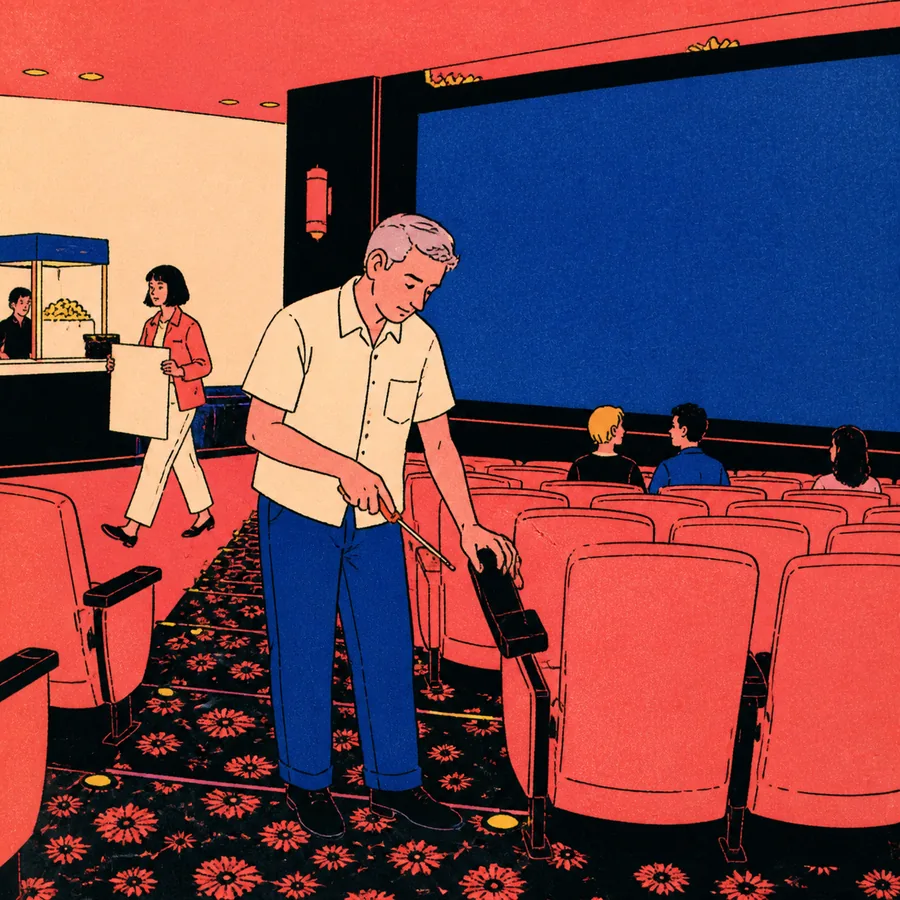
Leon Voss has worked the projection booth at the Marlowe Cinema for twenty-six years. On Thursday afternoons, before the monster-movie double feature, he walks down to Row G with a stubby screwdriver and tightens Seat 12. The left arm wobbles. It has always wobbled. Leon fixes it anyway.
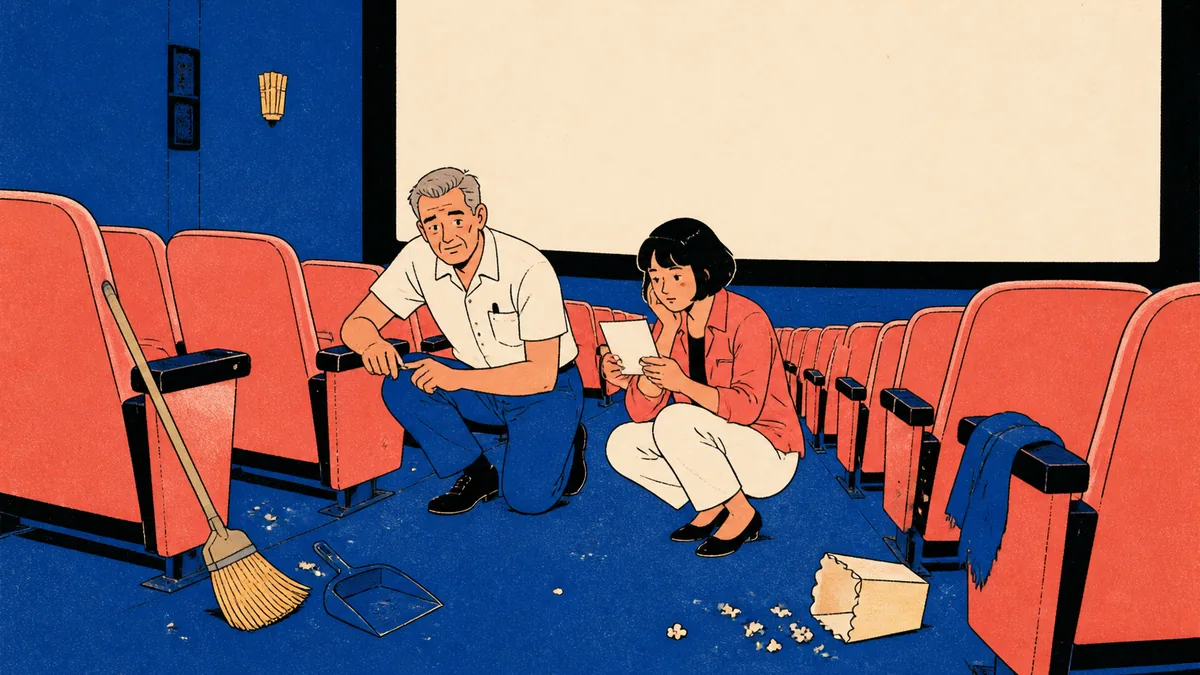
Ordinarily, this is part of his route. Check the exit lights. Sweep popcorn from the aisle edges where the night crew's broom has expressed a difference of opinion. Test the projector. Tighten G12. At six, nine regulars arrive for a film involving either a radioactive lizard or a scientist whose grant application has gone badly.
This Thursday, a handwritten sign waits on the lobby counter: LAST MONSTER NIGHT BEFORE RENOVATION.
The Marlowe has been sold. The new owners plan to split the auditorium into three smaller screens, replace the red seats, and convert the projection booth into something called a “premium lounge.” Leon has looked at the plans. The lounge contains six gray chairs, a refrigerator, and no obvious reason to exist.
Now his screwdriver means something it did not mean last week. That is where development begins: not with a list of traits, but with our understanding changing as a person meets a situation that will not let the old routine remain neutral.
Character development definition: what does the phrase include?
The phrase causes confusion because writers use it for two related jobs. The first is revealing who a fictional person is. The second is showing how that person becomes different, or refuses to, as events accumulate.
Both jobs develop a character because both alter the person available to the reader. Only the second necessarily creates a character arc.
At first, all we know is that Leon maintains an old theater and fusses over one loose seat. That might make him dutiful, lonely, territorial, practical, sentimental, or simply the only employee who knows where the screwdriver lives. The action is visible. Its meaning is not finished.
A profile would solve Leon early. It would tell us his childhood, his fear, his favorite film, his coffee order, the year he learned that attachment ends in loss, and probably his personality type, because fictional people apparently cannot avoid onboarding paperwork either. Some of that material may help the writer. Very little has earned a ticket onto the page.
The story develops Leon by returning him to decisions that expose what the details mean.
Mina, the sixteen-year-old volunteer who paints the lobby display cards, asks why he keeps fixing a seat that will be thrown out on Monday.
“People are sitting in it tonight,” Leon says.
That answer shows standards. It avoids grief. It puts the present audience ahead of the building's announced future. It also leaves room for Leon to be wrong about himself. Characters become interesting somewhere between what they say they are doing and what their hands keep doing.
This is why a trait is not yet development. “Leon is loyal” gives us a label. Leon repairing G12 after the sale gives loyalty a cost, an object, and an inconvenient Thursday afternoon. If he later hides the owners' survey report, loyalty may curdle into possession. If he helps Mina remove the seat and carry it somewhere useful, the same loyalty may acquire a future tense.
The earlier essay about writing better characters through consequential choices starts with the choices themselves. This question is slightly different. It asks how those choices accumulate until the reader knows somebody more fully—and can believe the person they become.
Characterization vs character development vs character arc
Characterization is how a story presents a person. Description, dialogue, thoughts, habits, relationships, narration, and other people's reactions all contribute. A narrator might tell us Leon is exacting. A scene might show him straightening a crooked EXIT sign while smoke curls from the popcorn machine.
Character development is broader. It includes that unfolding portrait and the way new events change the meaning of what we have seen. Leon's fussiness looks comic when it concerns the sign, generous when it keeps people safe, and frightening if he removes a warning label to protect the theater from an inspection.
A character arc is the line of meaningful change inside that larger development. The character may adopt a new belief, lose an old certainty, change how they act on a value, or descend into a worse version of themselves. The arc needs a before and after. Development can happen even when the person remains largely steady because the reader's understanding is still moving.
That distinction matters. Writers sometimes force a personality reversal when the story only needs revelation. A quiet character does not have to become loud. A guarded character does not owe the climax a clean speech about trust. A stubborn character may remain stubborn and finally spend that stubbornness on the right thing.
The ending should not feel as though somebody replaced the actor during intermission and hoped the hat would carry continuity.
Ursula K. Le Guin wrote about familiar writing rules as useful responses to beginner problems that become nonsense when promoted to laws. I would put “every protagonist must transform” in that same drawer. Sometimes the story's meaning comes from change. Sometimes it comes from the cost of remaining steady. Sometimes the reader changes their judgment while the character does not.
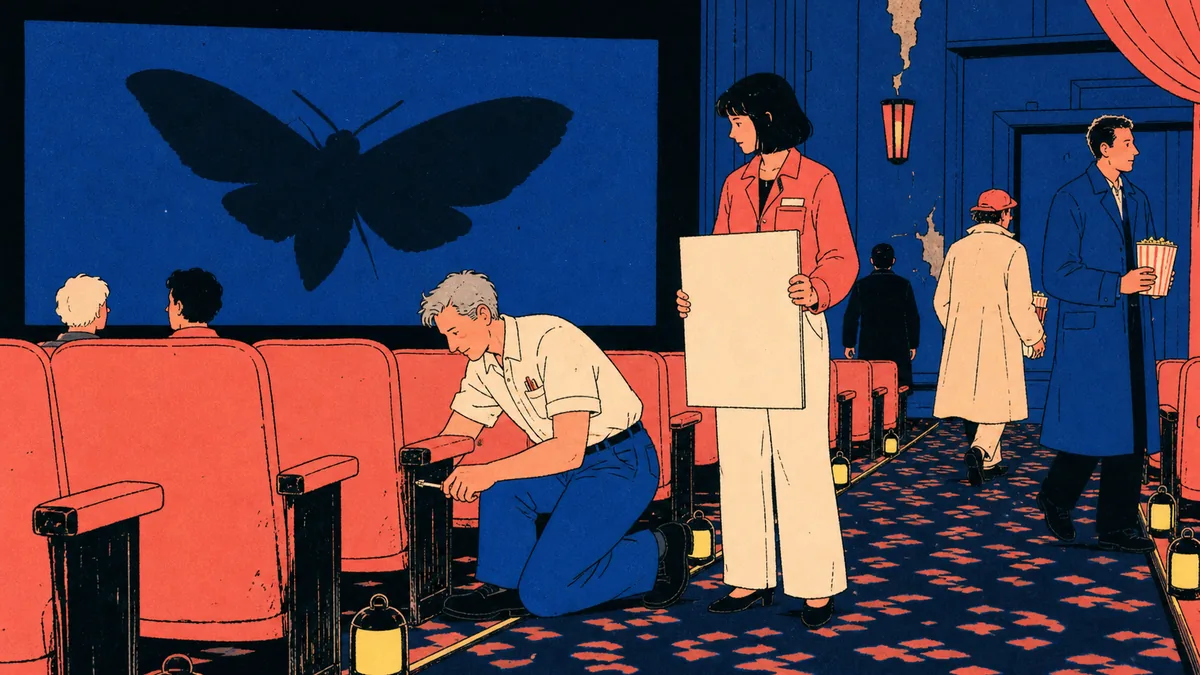
Imagine Leon rejects every renovation proposal. Mina initially reads him as an old man protecting his memories from any object manufactured after 1998. Then she discovers that he kept Thursday tickets cheap by quietly repairing equipment himself. Later she learns he also blocked captioning upgrades because he did not want the new system touching his projector.
Leon has not changed yet. Mina's understanding has. Ours has too. His devotion becomes more generous and less innocent. That is development before an arc appears.
How do you show character development on the page?
Return to the same kind of choice after the pressure has changed.
Early in the story, Leon finds Mina in the projection booth. Nobody is allowed there during a show. He tells her to leave before explaining what any of the equipment does. He is protecting the machinery, the audience, and his authority. The motives overlap so neatly that even Leon may not separate them.
Later, a reel jams during the final monster night. Leon can fix it, but not while keeping the old changeover projector aligned. Mina is downstairs. He can call her up or let the screen go white.
If he calls her, the action means more than “Leon learns to trust.” It answers the earlier scene. The forbidden room becomes a shared room under pressure. If he does not call her, the refusal also develops him—especially if we understand what it costs. Repeated choices let the reader measure movement without the narrator arriving with a clipboard.
The later scene should not be the same test with different wallpaper. It needs new knowledge, altered relationships, and consequences from what came before. Otherwise the plot resembles a driving instructor asking for the same left turn until the character achieves personal growth or hits a shrub.
This is where conflict that changes the next choice and character development meet. Leon wants the Marlowe to remain itself. He fears becoming unnecessary. That gives him actions: object to the plans, preserve the old equipment, make the final Thursday perfect, dismiss Mina's ideas, repair what nobody asked him to repair.
Each action changes the situation. The owners stop consulting him. Mina starts planning a farewell screening without permission. The regulars propose saving one row of seats. Character creates plot, and plot returns with muddy shoes to test the character.
Chuck Wendig describes character and plot as intertwined rather than rival departments. People pursue what they want and flee what they fear. Their actions cause trouble, and that trouble changes what they can do next.
Now the story can ask a better question than “Will Leon accept change?” Accepting change is a phrase printed on mugs in waiting rooms. What would acceptance require him to do? Teach Mina the projector? Let G12 be removed? Admit that some parts of the old theater excluded people? Choose which tradition is alive and which is merely heavy?
The concrete choice keeps the emotional change honest.
Character development examples: positive, negative, and flat
The person need not improve. Development is not a software update in which Chapter 18 finally patches the protagonist's sarcasm bug.
K. M. Weiland's character-arc work offers useful schools for positive, negative, and flat arcs. A positive arc moves a character toward a more honest or capable way of living. A negative arc moves them toward delusion, cruelty, isolation, surrender, or some other loss. A flat or steadfast arc tests a belief the character largely keeps while their actions change the surrounding world.
The categories are maps, not parole conditions. A story may cross their borders.
Elizabeth Bennet changes because she recognizes the limits of her first judgment. Macbeth changes because ambition and fear keep teaching him to choose worse. Columbo, in most episodes, does not need to become a new detective; the pleasure comes from watching his rumpled manner remain steady while the murderer revises an increasingly expensive opinion of him.
Those are different character development examples. None needs a moral improvement meter above the person's head.
For a positive version of Leon's arc, he might remain suspicious, exacting, and devoted to Thursday night. The change lies in what he believes preservation requires. He stops treating stewardship as sole possession.
For a negative version, he hides an electrical report to delay construction. The delay gives the regulars time to organize, but it also puts a worker at risk. He tells himself the report exaggerates. Then he removes a warning tag. Each worse action solves an immediate problem and makes the next step easier to justify.
For a flat version, Leon keeps believing that a neighborhood theater matters. Mina learns the booth, organizes the regulars, and forces the owners to preserve one full-size screen. Leon's steadiness becomes the fixed point other people act around. He still needs doubt, failure, temptation, and more revealed layers. Static does not mean laminated.
This is why before-and-after trait lists can mislead. Before: stubborn. After: flexible. Clean, printable, dead. More useful is behavior around the same value.
Before, Leon protects the theater by keeping Mina out of the booth. After, he protects it by teaching her which sound means the feed reel is slipping. The loyalty stays. Its behavior changes.
A steadfast character also needs changing pressure. If they answer every problem with the identical speech, they may not be profound. They may be a pull-string toy with excellent values. Let steadiness cost something. Let it require adaptation. Let the character choose the belief again when abandoning it would be easier.
Why backstory cannot develop a character by itself
Suppose G12 was where Leon's wife, Ana, sat during their first date. That fact explains his attention. It does not develop him. A tragic explanation is still an explanation, and tragedy is not concentrated character juice.
The useful question is what Leon does because the seat matters.
Perhaps he never tells Mina about Ana. He simply insists that G12 be saved. Mina assumes the chair has historical value and spends an afternoon checking old programs. When she finally asks, Leon says, “No. She hated that seat. The armrest rattled through every quiet scene.”
Now the memory is not a saintly relic. It contains annoyance, affection, and the ordinary comedy of two people returning to the same faulty chair. Leon may be preserving the rattle because love was partly the ritual of complaining about it.
Backstory earns page space when it changes present behavior. It may create a debt, promise, skill, mistaken belief, relationship, or refusal. A complete biography is not required before the first meaningful scene. Readers are allowed to judge a character too soon. Revising that judgment is one of reading's small, legal pleasures.
The order matters. “Leon treasured the seat because his late wife sat there” closes the circuit before we see him. Leon tightening the arm, defending the chair, irritating Mina, and only later admitting Ana hated it lets the reader participate. We do not merely receive information. We revise a person.
Direct characterization still has a place. “Leon had never liked being helped” gives us footing. Leon taking a ladder from Mina, carrying it three steps, and then asking her to hold the door gives us proof with a hairline crack in it. He accepts help only after renaming it.
Dialogue develops character for the same reason. The important question is what the person is trying to get, hide, delay, or protect. Leon tells the owners the projector is “temperamental,” when he means old, repairable, beloved, and not yours to insult. Mina calls the farewell show “content,” watches him flinch, and never uses the word again. Two vocabularies negotiate the room.
The essay on writing dialogue from different wants goes further into that work. Here, notice the changed language. Leon may eventually call the renovation a theater instead of a lounge. Mina may stop calling every old object history. Neither needs to announce the lesson. A changed noun can carry a surprising amount of luggage.
How does plot create believable character growth?
Characters in stories can change faster than people in life because stories select the moments that bear weight. Selection is not permission for teleportation.
If Leon spends two hundred pages refusing help and then hands Mina the booth keys because the climax has reached its scheduled emotional departure gate, the reader will feel the machinery. A believable change needs causes we can recover: failed attempts, costs, contradictions, small concessions, new information, and actions that become harder to explain with the old belief.
This does not mean planting twelve identical signs that say LEON WILL SHARE THE KEYS LATER. One or two quiet breaches may be enough. He lets Mina choose the second feature. He corrects her focus, then stops himself and watches her correct it. He refers to the booth as “ours,” gets annoyed, and changes the subject to bulb inventory.
People often practice a new self accidentally before they can describe it.
Good positive and negative arcs both preserve cause. Leon should not suddenly adore gray lounge chairs and use “synergy” without medical supervision. Nor should he become a saboteur because the outline needs an antagonist by Friday. At each step, the action should relieve a real pressure, expose a cost, and make the next action possible.
Not every supporting character needs the same treatment. The cashier can be vivid without confronting a childhood lie between popcorn refills. Mina's mother texts her at 8:45 every Thursday: HOME BY TEN. The first week, Mina lies that the show ended early. On the final night, she hands Leon the phone and asks him to explain why a fifty-foot radioactive moth has delayed public transportation.
We learn something about Mina, her mother, and Leon without opening three subsidiary arcs and a family calendar. A minor character may need one sharp contradiction, one relationship-specific behavior, or one changed response. Development should match the space and job of the person.
How to develop a character in revision
When a character feels thin, I would not begin by adding a hobby or another wound. Find two scenes in which the person faces related pressure. What do they choose early? What do they choose later? What changed between those moments? If the answer is “the outline says they learned,” the pages need more weather.
Look for the missing cause. Did another person earn trust? Did the old behavior fail? Did success reveal an uglier cost? Did the character receive information they could not dismiss? Did they try the new action badly before managing it well? Did they lose the excuse that protected the old self?
Then revise backward. Plant the possibility without hanging a neon arrow over it. A story discovered in drafting is not dishonest because the writer adds its roots later. That is revision doing its actual job, which is less like proofreading and more like realizing the wall you painted is not attached to the house.
A novel outline that leaves room for discovery can change when the character becomes more specific. The plan is useful evidence of what you once expected. It is not a witness who can identify the suspect.
At the Marlowe, the final reel burns near the last scene. The screen blooms white. Nine regulars groan. Someone applauds, because there is always one person who interprets equipment failure as audience participation.
Leon reaches for the spare reel, but the changeover motor sticks. He cannot hold the film path, reset the motor, and keep the lamp from scorching the frame. Mina is already at the booth door.
Earlier, he would have blocked it with his body.
Now he hands her the screwdriver.
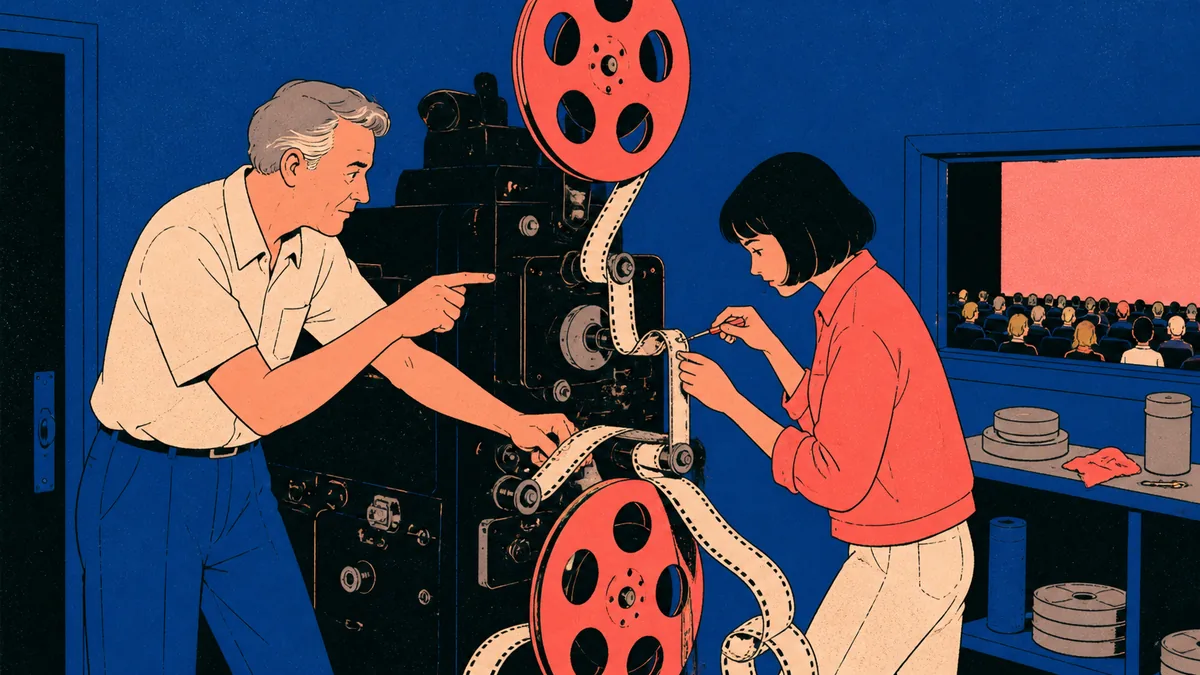
The moment works if the story made the tool particular, the room forbidden, and the help costly. It fails if Mina instantly repairs a projector she has never touched. Character development does not repeal mechanical knowledge.
Leon points. Mina holds the tension arm where he shows her. The film catches, shudders, and moves. Onscreen, the monster rises from the harbor missing four seconds of important municipal destruction. The regulars survive the gap.
Afterward, Leon walks to G12. He does not tighten it. He and Mina unbolt the chair from opposite sides. Leon complains about the wrench. Mina says the wrench is fine. The seat lifts with a sound like a metal animal waking up.
What happens to it can remain undecided. The owners may keep one row. The regulars may put G12 in the lobby. Leon may take it home and discover that a cinema chair looks less romantic beside a washing machine. The story's arc is not the disposal plan.
The movement is that Leon no longer believes caring for the Marlowe means being the only person allowed to touch it. That belief has not vanished into a speech. It has become a different action performed with the same scarred screwdriver.
Useful answers, briefly
Character development FAQ
What is the difference between characterization and character development?
Characterization is the collection of choices a story uses to present a person: description, action, dialogue, thought, relationships, and narration. Character development includes that unfolding portrait plus any meaningful change, deepening, or revision in how the reader understands the person.
Is character development the same as a character arc?
No. A character arc is the line of change from one meaningful state to another. Character development is broader and can include revelation, contradiction, and a deepened understanding of a character who remains largely steady.
Does every character need to change?
No. A protagonist can hold a central belief while pressure tests it and their steadiness changes other people. The story still needs to reveal new layers, costs, doubts, or adaptations; static is not permission to repeat one note.
What are static vs dynamic characters?
A dynamic character changes meaningfully during the story. A static character remains largely consistent, though the reader may understand them differently and they may adapt their tactics. Both can be developed well or badly.
Can character development be negative?
Yes. A character can become more isolated, dishonest, cruel, fearful, or committed to a damaging belief. A convincing negative arc makes each step understandable without pretending the damage is admirable.
How do you show character development without saying it?
Give the character a related choice at two or more points in the story, then change the knowledge, cost, relationship, or pressure around it. The reader can infer development from the difference between the choices and the causes the story has supplied.
The rule of thumb
Repeat a related choice after the cost has changed.
Find one action your character takes early because of what they believe. Make the story complicate that belief. Later, give them a related choice with a cost the opening could not yet contain.
Do not ask whether they improved in every category. Ask whether the later action was possible for the person you introduced, and whether the pages made the distance believable.
Leon sets G12 on the lobby carpet. Mina reaches for the broom. “Leave the dime,” he says. “The new owners can have some history.” Then he gives her the screwdriver.
Further reading
Sources
- K. M. Weiland (opens in a new tab) supported the distinction among positive, negative, and flat character arcs and the idea that a steadfast character can still be tested.
- Ursula K. Le Guin (opens in a new tab) supported treating familiar writing rules as useful guides rather than universal laws.
- Chuck Wendig (opens in a new tab) supported treating plot and character as intertwined through wants, fears, actions, and consequences.