Worldbuilding · Essay 06
How to Build a Fantasy World Your Characters Can Live In
Start with one impossible fact. Then find out who has to live with it on an ordinary Tuesday.
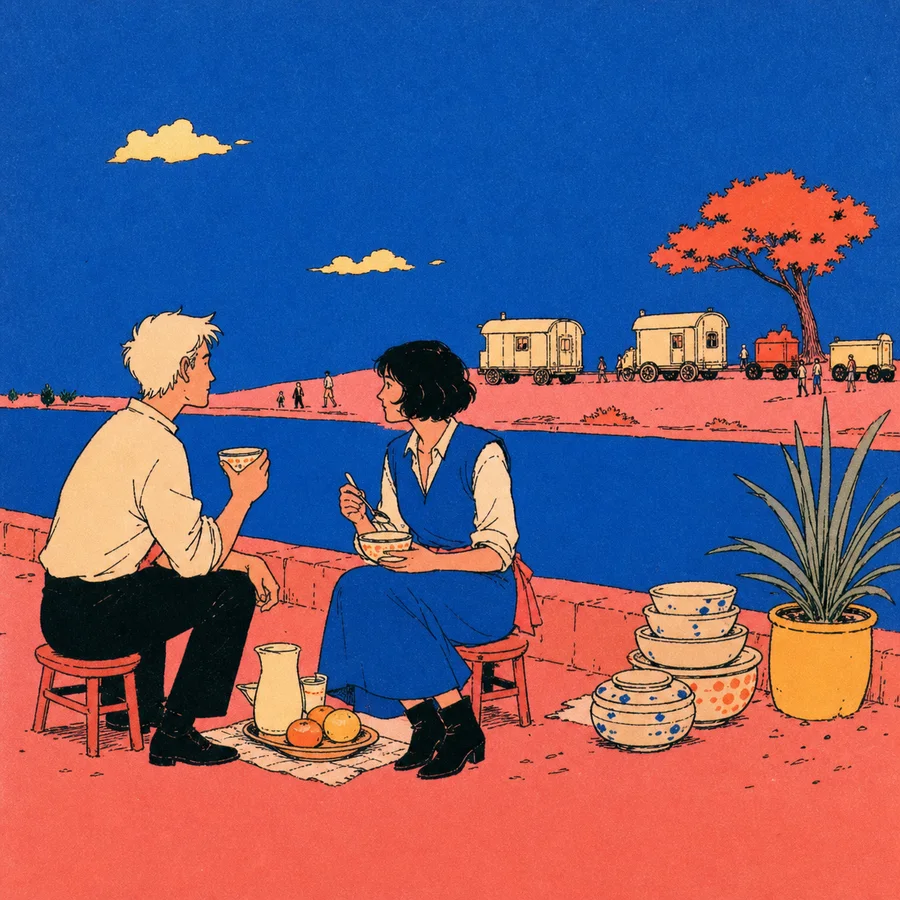
If you want to know how to build a fantasy world, start with one impossible fact and follow it into somebody's ordinary life. In Orra, the river changes course every spring, and the town follows. Houses roll onto the road, market stalls fold, and the temple crew packs the saint into a wagon. Tala is a potter. Her bowls can travel. Her kiln cannot.
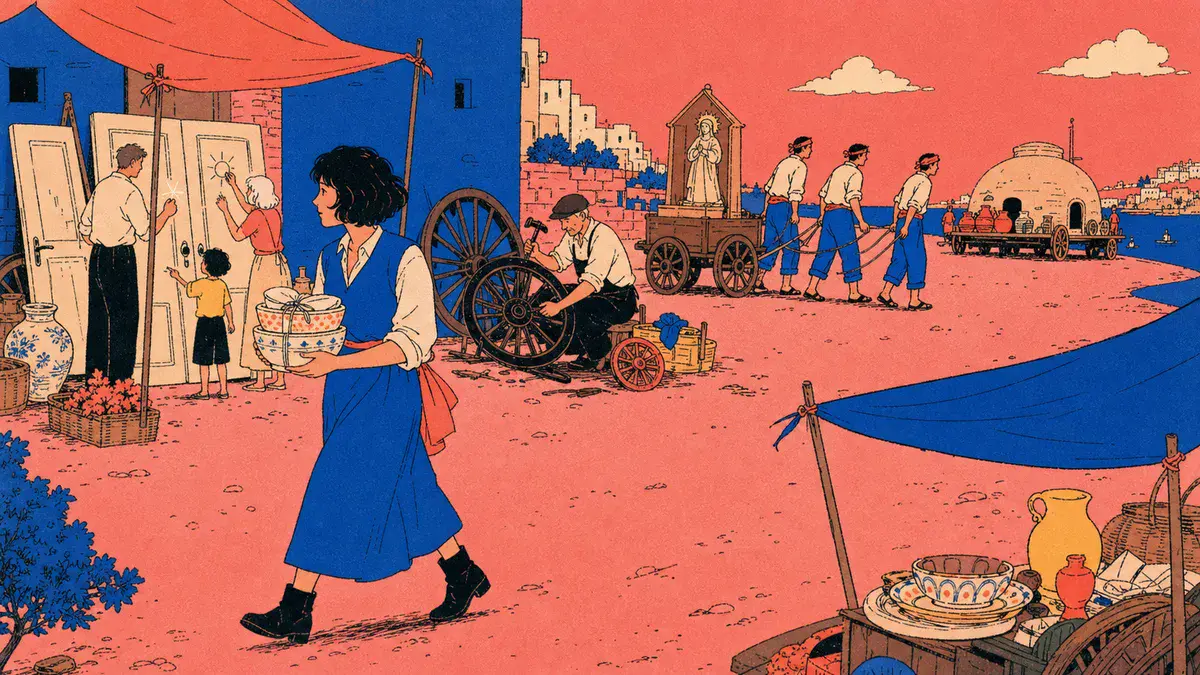
Every year, when the white blossoms open upriver, Orra starts dismantling itself. The move is familiar enough to have its own songs, arguments, and specialists. Families chalk their names on door panels. Neighbors negotiate cart space. The wheelwright stops answering knocks after sunset.
Most years, Tala has time to let her kiln cool, salvage the best bricks, and build another beside the river's new course. This spring, the blossoms open a month early while her largest order of blue bowls is still in the fire. Orra leaves at dawn. The firing and cooling need two more days, and the river will cover the north road by dusk on the third. Tala can leave with the town and lose the order, or stay with the kiln and give herself one day to catch them.
How to create a fantasy world from an inconvenience
A fantasy premise often arrives dressed for the cover. A city floats. The dead answer questions. Winter has lasted ninety years. These are fine beginnings, but they are still views from a distance. The world starts to feel inhabited when somebody has to sweep the snow, apologize to a ghost, or decide whether the floating city permits window boxes.
A better question is, “Who has had time to become annoyed by it?”
The people of Orra do not stand beside the river every spring and admire the miracle. They argue about cart space. They know which wheelwright drinks. They have songs for lifting a house, most of them rude. Children spend the moving week racing abandoned doorframes until an adult remembers that doorframes are expensive.
That ordinary inconvenience does more than a paragraph announcing that the townspeople have adapted. It lets the adaptation appear in habits, jobs, slang, furniture, grudges, and the bits of civic life nobody would put in a prophecy.
Tala's kiln gives us a second question. If most of the town is built to move, what happens to the things that cannot? Orra's potters salvage their best bricks and build again beside the new riverbank. An early move still leaves fires burning and orders unfinished. A wealthy family owns a kiln on wheels and treats this engineering triumph with the humility of a peacock entering a pantry.
I would not decide immediately which option Tala takes. I would write her walking through the market while everyone prepares to leave. Let her pass the wheelwright, the temple crew, the family with the vulgar mobile kiln. Let her notice what she envies. The scene will tell us which part of the world has begun to matter.
Fantasy world building works by following consequences
The easiest way to make a fantasy world look large is to add things. Another kingdom. Another god. Another school of magic with examinations, uniforms, and a dean who is worried about funding.
The more convincing move is often to follow one thing farther. If Orra moves with the river, houses need wheels. If houses have wheels, wealth may be measured partly in axles, draft animals, and the number of relatives willing to push. A person can inherit a bedroom but not the wagon beneath it. A landlord may own the floor while the tenant owns the walls. A divorce could become extremely literal.
Now the premise has reached property, class, family, and law without our consulting a list labeled PROPERTY, CLASS, FAMILY, AND LAW. Those parts arrived because Tala needed a cart. This consequence chain is how one unusual condition begins to suggest a whole place.
The same can happen at the smaller end. What does breakfast look like on moving day? Which food survives the road? Where do people bury their dead if the town will be gone by Tuesday? Does a promise made on one riverbank still bind you on another? Who stays behind?
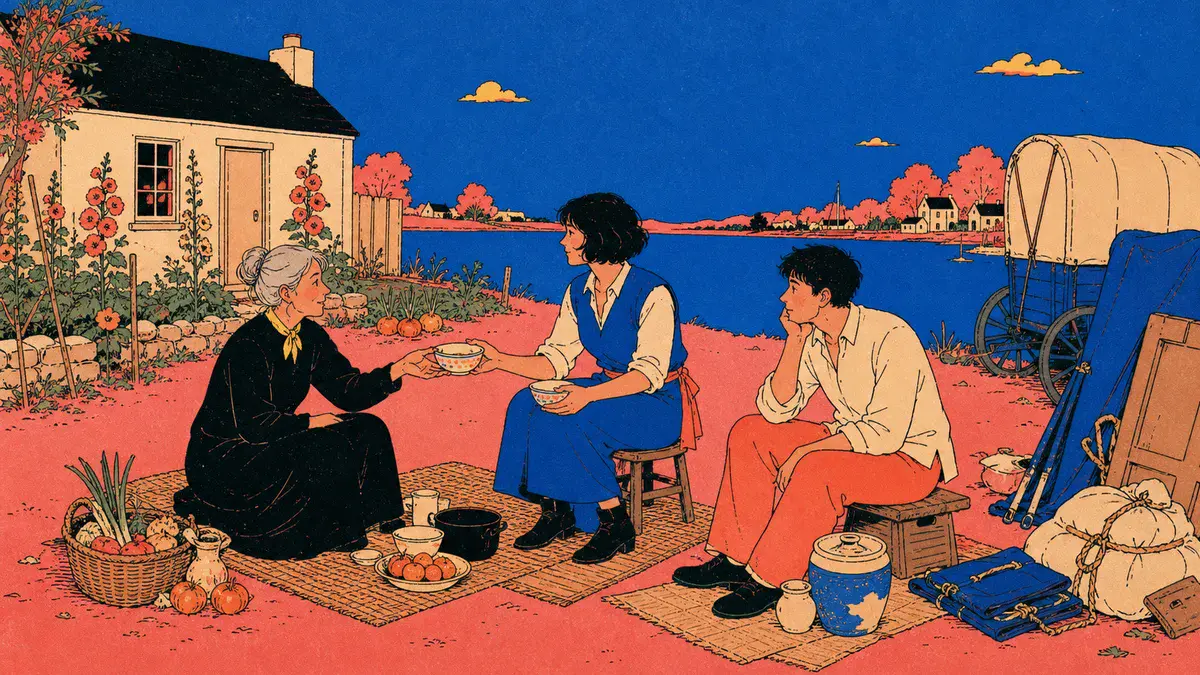
The last question gives us the Rooted. Maybe some people believe the river is leading them toward a promised sea. Others believe it is fleeing something. Others have heard both sermons since infancy and mainly want to know whether the next campsite has onions. A few refuse to follow at all. The town calls them Rooted as an insult. Some of them have kept the name.
Tala knows what people will call her if the river closes the road before she catches up. She also knows some of the Rooted will understand why she took the risk.
Fantasy worldbuilding questions begin at the fault line
Brandon Sanderson advises writers to focus on the parts of a world that affect the story and to place characters near the setting's conflicts. That is useful because a setting becomes legible fastest at a fault line: the place where people cannot agree about how to live in it.
Tala does not need to be the mayor, river priest, chief engineer, or lost heir to anything. She can be a potter whose work puts her in an awkward place. The moving town needs light, durable dishes. Her best bowls are heavy. Her blue glaze requires three days of steady heat, and this firing began yesterday. Her customers praise the color and then ask whether she could make it thinner.
She is caught between the town's practical life and the beautiful thing she knows how to make. That is a modest conflict, which is one reason I trust it. We can enlarge it later if the book asks. For now, it gives Tala a reason to care about carts, fuel, river signs, the Rooted, and the rich family's traveling kiln. If she still feels vague, the better next step is to work on the choices that reveal a character, not to assign her a favorite mineral.
It also prevents the world from agreeing with itself. A weak invented culture sometimes behaves like one person wearing ten thousand hats. Everybody reveres the river. Everybody fears magic. Everybody considers left-handed soup spoons a disgrace. Real groups contain devotion, boredom, opportunism, doubt, and somebody who did not attend the meeting.
Orra should, too.
The river priest may sincerely love the journey. His daughter may be sick of folding the temple. The wheelwright may call the Rooted cowards while quietly buying their old iron. Tala's brother may enjoy the move because it gives him a week when nobody asks when he plans to marry. None of these positions needs to represent the town. Together they make the town possible.
How much of the fantasy world needs an answer?
Patricia C. Wrede's fantasy worldbuilding questions range across climate, government, family, language, magic, and daily life. The important part of her introduction is easy to miss: not every question applies, and a writer does not have to answer them all before starting.
Wrede's list works best when you choose only the questions the current story needs.
If Tala is trying to save her kiln, questions about fuel, labor, trade, property, and the river's route may open useful doors. Questions about the dominant textile weave three kingdoms away can wait until somebody in the story needs cloth.
This does not mean the rest of the world is fake. It means the novel has a point of view. A person can live a convincing life without knowing the name of every mountain in her country. Most of us are doing it now.
The unanswered parts can even create a useful blank. Tala has heard there are towns that stay in one place. She imagines their streets as very clean and their people as slightly unwell. She knows the river eventually reaches the sea, but nobody she trusts has seen it. Children dare one another to sleep in houses left behind. The world continues past the edge of Tala's certainty without requiring an appendix to stand there waving.
There is a limit to this advice. Some writers love building languages, dynasties, ecosystems, and calendars before they know who the book follows. The building is part of the art for them. I see no reason to confiscate their notebooks.
The trouble begins when the notebook starts checking the story's paperwork.
When do a worldbuilding template and fantasy world map help?
Glen C. Strathy suggests that a writer can begin with an intriguing scene and develop the world while drafting, then check for contradictions. I like that order because the draft tells me what matters, and revision keeps the answers from changing by accident.
Suppose I write three chapters and discover that Orra's poor families travel on foot. In chapter four, Tala's brother casually lends a spare cart to a stranger. That may be generosity, wealth, theft, or a mistake. The draft has made a claim whether I intended it or not.
This is where a worldbuilding template or a plain notes page becomes useful. Not because the writer must complete a ceremonial world bible, but because invented facts have started making promises to one another. I would keep a few continuity notes: the river changes course after the white blossoms open; most buildings move on wheels; cart space is a sign of wealth; the Rooted reuse what the town leaves; Tala's blue glaze needs three uninterrupted days of heat.
My notes would contain only what the current draft has asked me to remember. The same principle works with a novel outline that leaves room for discovery: record enough to protect the next piece of writing, then return to the writing.
A question list can do a second job. Point it at a live part of the story. If a prompt produces a better conflict, image, custom, or choice, keep it. If it produces a paragraph nobody in the book wants, let it go.
When should you draw the fantasy world map?
A fantasy world map earns its place when distance, borders, weather, resources, or terrain change what a character can do. Orra may need one as soon as the river chooses a route that brings it near a hostile town, strands it above a canyon, or forces Tala to find clay somewhere new.
Before then, a sketch may be enough. Mark the old riverbed, the road, the hill where the Rooted have settled, and the place Tala's kiln is cooling. The map is helping the scene rather than decorating the endpapers.
Maps also expose contradictions. If Tala walks from the kiln to the market in ten minutes, the next chapter should not require a day unless something has changed. If the rich family's cart blocks the only bridge, we should know whether Orra has another way across. Geography becomes useful when it removes options.
If the story never cares which side of the mountains grows pears, the pears can remain geographically independent.
How do you put the fantasy world into motion?
Eventually the reader must meet Orra. The temptation is to greet them at the gate with a short lecture on migratory hydrology, civic wagon law, and detachable saints.
Tala packing bowls would be better.
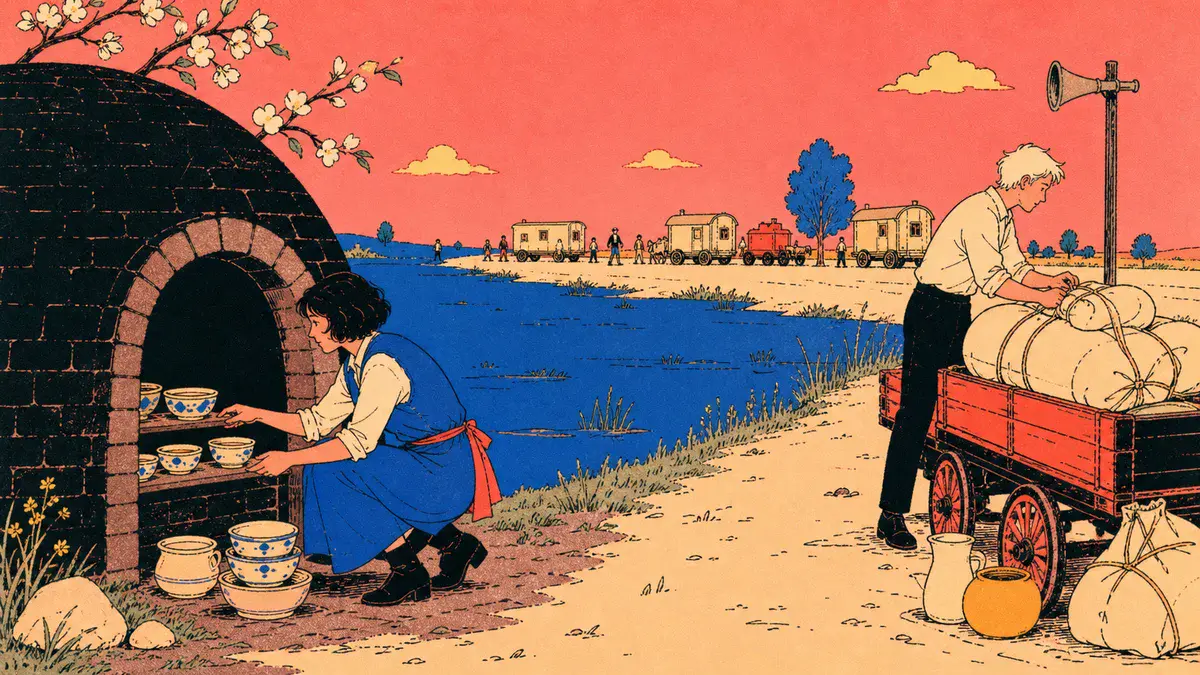
Her brother wants to leave before the north road turns to mud. She keeps returning to the kiln to check the glaze. A customer arrives carrying a cracked blue bowl and asks for another exactly like it. The temple wheels groan past. Somewhere upriver, a horn sounds once.
This is the scene test. Each piece of the world should change what somebody does. The horn matters because Tala has less time. The temple wheels show that even sacred things have been redesigned to travel. The cracked bowl tells us her work is valued and fragile. Her brother's impatience tells us leaving late has consequences.
If the brother says, “You know what happened to the Clay Street families last year,” we may not need the full story yet. The world can possess a past before the reader receives minutes from the inquiry.
Dialogue helps here. People reveal a culture through what they assume, contest, and refuse to explain. A Rooted woman will not describe herself as part of a fascinating counter-tradition. She may tell Tala that the town has been running after water so long it has forgotten the use of legs.
Tala may reply that at least her house has a roof.
And there, without a panel discussion, are prejudice and two different ideas of home. The same instinct that makes dialogue sound like two particular people can keep worldbuilding from turning into a guided tour.
Useful answers, briefly
Fantasy worldbuilding FAQ
What should I build first in a fantasy world?
Begin with the unusual condition that most affects the character or story you want to write. Then work outward through its immediate consequences: home, work, relationships, status, danger, travel, or belief. You do not need the whole continent before you can write the first scene.
How much worldbuilding should I do before writing?
Do enough to make the opening pressure understandable and to avoid contradictions you already see coming. Some writers discover best through notes; others through scenes. The useful amount is the amount that helps you draft without making the draft wait indefinitely for permission.
Do I need a fantasy world map?
No. Make one when location, distance, terrain, borders, climate, or travel time changes the story. A rough sketch is often enough during an early draft. A polished map can wait until the geography has stopped moving under your own feet.
How do I make a fantasy world feel original?
Originality rarely comes from inventing one object nobody has seen. It grows from the connections among familiar and unfamiliar things. Follow how your premise changes ordinary life, then let different people want different things from those changes.
Can I build the world while writing the story?
Yes. Drafting can reveal which parts deserve depth. Keep brief continuity notes as facts appear, and use revision to reconcile contradictions. Discovery and consistency do not have to happen at the same moment.
The rule of thumb
Begin with one impossible fact, follow it into ordinary life, and put the consequence in front of somebody who wants something else.
Then write the scene.
Perhaps Tala leaves with the town. Perhaps she stays with the kiln. Perhaps she discovers that the rich family's rolling furnace has one wheel sinking into the mud and experiences a moment of compassion she will later deny.
I would begin before deciding. Tala is wrapping the last of the blue bowls. The horn upriver sounds again. The kiln is still warm.
Somewhere beyond the houses, the river has started to move.
Further reading
Sources
- Brandon Sanderson (opens in a new tab) supported the story-facing limit on worldbuilding and the suggestion to place characters near the conflicts already present in the setting.
- Patricia C. Wrede (opens in a new tab) supported the use of worldbuilding questions as optional prompts rather than prerequisites, along with questions that expose variation inside cultures.
- Glen C. Strathy (opens in a new tab) supported beginning with an intriguing scene, developing the world while drafting, and checking the resulting invention for contradictions.